
Why this matters
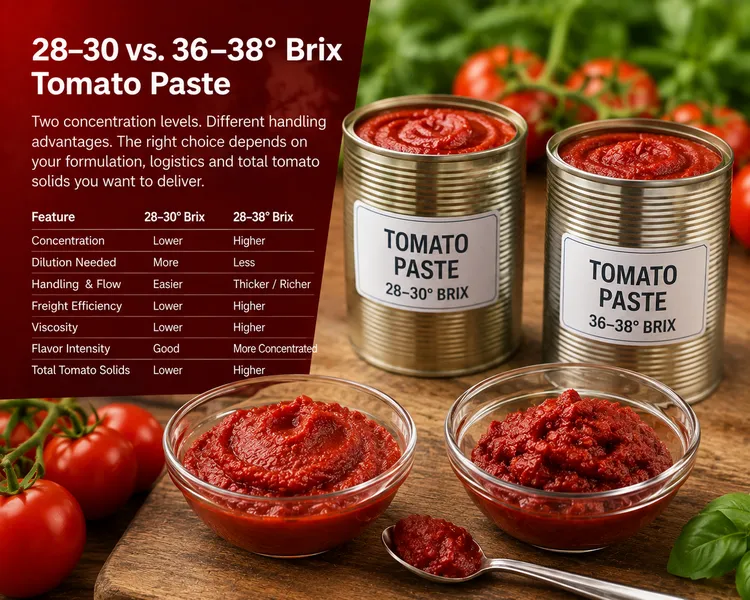
The difference between 28–30° and 36–38° Brix tomato paste is primarily one of concentration, but that difference affects more than formulation mathematics. It can influence freight, storage, dilution, pumping, product recovery and the amount of paste required per batch.
The specification is the commercial translation of finished-product performance. Concentration should therefore be evaluated together with process type, viscosity, color, pH, flavor, package format and total usable cost.
What Brix means in this comparison
Brix is used as a practical measure of soluble solids concentration in tomato products. In purchasing terms, a 36–38° Brix paste carries more concentrated tomato solids per kilogram than a 28–30° Brix paste.
That does not automatically make one grade better. The useful question is how much paste and water are needed to deliver the required finished-product tomato solids under the plant's actual processing conditions.
Ingredient selection
Start with solids/Brix and process type, then add consistency, color, pH or acidity, finish, microbiological requirements, packaging and lot documentation.
For this topic, a logical first comparison is 28–30° Brix and 36–38° Brix tomato paste. Treat concentration as one formulation and sourcing variable rather than assuming that the higher-Brix product is always preferable.
28–30° Brix paste
A 28–30° Brix paste contains a lower concentration of tomato solids than a 36–38° Brix product. For a fixed finished-solids target, more paste and less added water are normally required.
This grade may fit plants that prefer somewhat easier product handling or formulas already designed around double-concentrated paste. Its commercial value still depends on delivered price, process behavior and finished-product yield.
36–38° Brix paste
A 36–38° Brix paste contains more tomato solids per kilogram, so less paste is required to deliver the same solids contribution. More dilution water is generally added at the manufacturing plant.
The higher concentration can improve the amount of usable tomato solids transported and stored per unit weight, but the paste may also require greater attention to unloading, pumping and complete recovery from the package.
Normalize tomato solids before comparing performance
Equal-weight trials are misleading when comparing these two concentration ranges. If the same number of kilograms of each paste is added, the higher-Brix sample delivers considerably more tomato solids.
Calculate the paste addition required for equivalent tomato solids first. Then adjust water so both trial batches reach the intended formulation basis before judging viscosity, color, flavor and yield.
Build a simple solids balance
For practical product development, record the incoming paste Brix, paste weight, added water and target finished solids. This allows the technical team to separate concentration differences from true differences in ingredient performance.
Once a supplier is selected, the actual formula can be optimized around the approved Brix range rather than recalculated from scratch for every delivery.
Water addition
Higher-concentration paste requires more added water to reach the same finished tomato solids. That water may already be part of the formula, or the change may require a different sequence of dilution and ingredient addition.
Check whether the plant has sufficient controlled water addition, mixing capacity and batch volume to accommodate the selected concentration efficiently.
Viscosity is not determined by Brix alone
A higher Brix does not automatically mean that the finished sauce will be thicker after both pastes are normalized to the same tomato solids. Process type and the characteristics of insoluble tomato solids also affect consistency.
Compare hot-break or cold-break process, Bostwick or viscosity specification and actual finished-product performance separately from concentration.
Process type still matters
A 28–30° Brix hot-break paste and a 36–38° Brix cold-break paste differ in more than concentration. Comparing them without accounting for process type can lead to the wrong conclusion about why texture or flavor changed.
Wherever possible, compare technically similar grades so Brix is the main variable being tested.
Color
Concentration can influence the appearance of the incoming paste, but finished color should be judged after equivalent-solids dilution and the normal production process.
Review supplier color data together with application trials because crop, processing and heat history can create differences even between products with similar Brix.
Flavor and aroma
Evaluate tomato aroma, sweetness, acidity perception, cooked character, bitterness and overall tomato intensity after solids normalization.
If one paste appears more flavorful only because more solids were added, the comparison is not technically fair. Sensory evaluation should follow an equivalent solids adjustment whenever practical.
Pumping and unloading
More concentrated paste can be more demanding to move through some handling systems. Review unloading equipment, pump capability, hose dimensions, transfer distances and operating temperature where relevant.
A concentration that is commercially attractive in freight terms can lose part of that advantage if unloading is slow or significant paste remains in the package.
Product recovery
Record how much paste remains in the drum, bin or liner after normal emptying. The effective cost of the ingredient depends on usable paste, not only invoiced net weight.
Recovery becomes especially important when comparing higher-solids grades because residual paste also represents a relatively larger amount of unused tomato solids.
Storage efficiency
Higher concentration can reduce the weight and warehouse volume needed for a given amount of tomato solids. This may be valuable when storage capacity is constrained or long supply chains make freight efficiency important.
Storage economics should still include pack format, stacking restrictions, warehouse handling and inventory turnover.
Freight efficiency
Because 36–38° Brix paste contains more tomato solids per kilogram, fewer kilograms are needed to move the same solids quantity. This can improve freight efficiency on a usable-solids basis.
Compare landed cost per equivalent tonne of tomato solids rather than freight cost per tonne of paste alone.
Batch size and plant capacity
A concentration change affects the quantities of paste and water entering each batch. Confirm that the selected formula fits kettle capacity, water addition limits, pump capability and normal production scheduling.
This becomes particularly important when an existing formula designed for 28–30° Brix is converted to 36–38° Brix or vice versa.
Practical trial method
Run both candidate grades in the actual formula at equivalent tomato solids. Record paste and water weights precisely so differences in finished performance can be attributed to the ingredient rather than concentration alone.
- Define the finished-product target and identify Brix, viscosity, color, flavor and yield attributes that cannot change.
- Collect current specifications, COAs and representative 28–30° and 36–38° Brix samples.
- Record incoming Brix, process type, viscosity or Bostwick, pH, color and finish.
- Calculate the paste quantities required to deliver equivalent tomato solids.
- Adjust water so both test formulas use the intended finished-solids basis.
- Run controlled bench or pilot batches using the real addition order and process conditions.
- Measure finished Brix, pH, viscosity or Bostwick, color, yield and other relevant technical parameters.
- Compare tomato flavor, aroma and overall sensory balance after the intended thermal process.
- Record unloading, pumping and product-recovery observations where plant handling is part of the decision.
- Document the approved concentration range, supplier specification and change-control triggers.
What to record during trials
- Ingredient lot & COA
- Incoming Brix
- Hot-break / cold-break process
- Viscosity / Bostwick
- Paste weight
- Water addition
- Equivalent tomato solids
- Batch weights
- Process temperature/time
- pH & final Brix
- Color & sensory
- Product recovery
- Finished yield
- Storage result
Compare formula yield
Yield should be calculated from the complete formulation, not simply from paste use rate. Higher-Brix paste may reduce ingredient weight while requiring additional process water to reach the same target.
Compare how many kilograms of finished product are obtained from a defined amount of purchased paste and how that translates into cost per finished unit.
Compare total usable cost
The lowest quoted paste price does not necessarily produce the lowest finished-product cost. Include Brix, freight, water, storage, unloading labor, pumping, product recovery and formulation adjustments.
For industrial purchasing, cost per usable tonne of tomato solids is often a more informative starting point than cost per tonne of paste.
Supplier specification range matters
Purchasing a nominal concentration range means actual lots may vary within that range. Understand the supplier's guaranteed minimum and maximum and how the plant adjusts formulation for incoming Brix.
A narrow and consistent operating range can simplify water adjustment and production control.
Receiving controls
Confirm incoming Brix and lot documentation according to the approved receiving plan. The physical ingredient, supplier COA and purchasing specification should all refer to the same lot.
If formulation water is adjusted according to actual incoming concentration, ensure the released Brix value is available to production before batching.
Questions to ask the supplier
- What exact Brix range is guaranteed for this grade?
- Is the product 28–30° or 36–38° Brix on the commercial specification?
- What hot-break or cold-break process applies?
- What viscosity or Bostwick specification applies?
- What pH, acidity, color and finish ranges apply?
- Which parameters are guaranteed versus typical?
- What normal lot-to-lot Brix variation should buyers expect?
- What manufacturing site and crop/origin apply to the program?
- What pack configuration and exact net weight apply?
- What storage and handling guidance applies?
- Which food-safety and quality documents are available?
- How are lots identified and traced?
- What normal lead time and shipment configuration apply?
- What concentration, process, specification, site or packaging changes require customer notification?
Define the approved concentration strategy
Once trials are complete, document whether the plant is approved for one concentration range or both. If both are acceptable, define the formulation adjustment used to normalize tomato solids.
Keep that instruction linked to the approved specification so purchasing can change concentration without creating an uncontrolled formula change.