
Why this matters
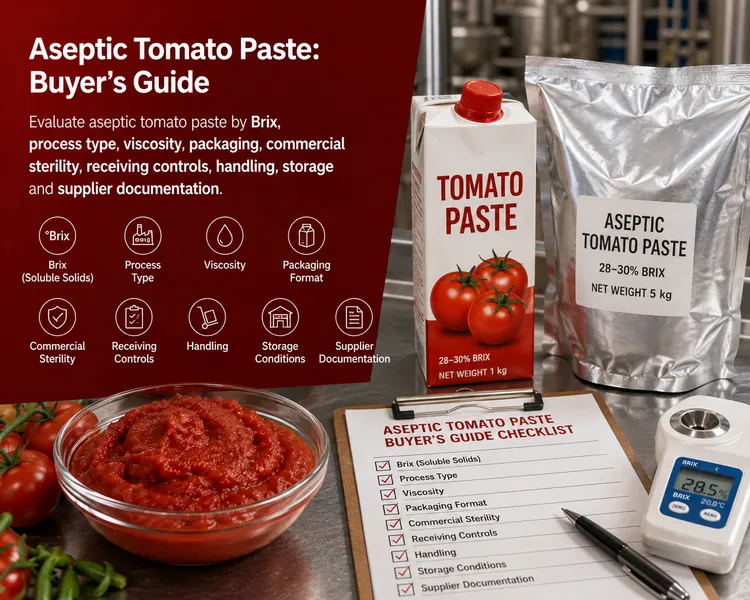
Aseptic tomato paste is more than concentrated tomato solids in a bulk package. A buyer is qualifying the paste specification, the processing route, the aseptic packaging system, the supplier's lot controls and the practical way the ingredient will be received and used at the plant.
The specification is the commercial translation of finished-product performance. A relatively small change in Brix, viscosity, color, process type or paste character can alter finished yield, pumping behavior, sensory profile and the amount of water or thickener required.
Start with the finished-product requirement
Define what the paste must do in the final product before comparing offers. Ketchup, sauces, soups, ready meals, beverages and culinary bases can place very different demands on tomato solids, consistency, color and flavor.
Identify the attributes that cannot change, such as finished Brix, target viscosity, tomato flavor intensity, color or processing behavior. These become the basis for the purchasing specification and supplier trial.
Ingredient selection
Start with solids/Brix and process type, then add consistency, color, pH or acidity, finish, microbiological requirements, package format and lot documentation.
For this topic, a logical first ingredient to evaluate is aseptic tomato paste. Treat that as a formulation hypothesis rather than a fixed rule. The preferred paste is the one that meets the finished-product target at an acceptable total cost with reliable commercial supply.
Choose the appropriate concentration
Brix or tomato-solids concentration is one of the first commercial variables to compare. A more concentrated paste provides more tomato solids per kilogram but can also influence handling, dilution and pumping.
When evaluating suppliers, compare products on an equivalent tomato-solids basis rather than relying only on quoted price per tonne. This creates a more meaningful comparison of ingredient yield and formulation economics.
Hot break versus cold break
Process type can influence paste consistency, flow, color and sensory character. Hot-break paste is commonly evaluated when stronger body or viscosity is important, while cold-break paste may provide a different flow, color or flavor profile.
The process designation alone is not enough to approve a source. Confirm the actual viscosity or Bostwick range and trial the candidate in the intended finished product.
Consistency and viscosity
Tomato paste can make a significant contribution to finished-product body. Review the supplier's consistency specification and use the analytical method relevant to your application.
Measure the final product after normal dilution, mixing, pumping and heat treatment because commercial shear and processing can change apparent viscosity.
Color
Color is especially important in tomato-forward formulations. Review supplier color data together with visual evaluation of the paste and the finished product.
The same paste can appear different after dilution, cooking and combination with spices, sugar, starches or other ingredients. Final approval should therefore reflect actual application performance.
Flavor and sensory profile
Compare tomato aroma, sweetness, acidity perception, cooked character, bitterness and overall tomato intensity. Crop and processing differences can influence sensory performance even when analytical specifications are similar.
Sensory work should be performed in the real formula whenever practical because a difference that is obvious in diluted paste may become less important after complete formulation and processing.
pH and acidity
Review pH and acidity where they form part of the purchasing specification or affect finished-product formulation. Changing suppliers may require small adjustments to acid or seasoning balance.
Analytical values should always be considered together with the validated finished-product process rather than used as a substitute for process validation.
Understand aseptic processing
Aseptic tomato paste is produced and filled through a controlled processing and packaging system intended to protect the product after treatment. Buyers should view the thermal process, hygienic transfer, aseptic filling and package integrity as one connected control system.
Supplier qualification should establish that the approved manufacturing site uses a defined process and appropriate lot-release controls for the commercial program.
Commercial sterility and release controls
Commercial sterility should not be reduced to one laboratory number. The supplier's process controls, filling system, package integrity and release procedures work together to support the condition of the finished aseptic product.
Buyers should understand what documentation or verification accompanies each lot and what information is available during supplier qualification.
Packaging format
Aseptic paste is commonly supplied in bulk packages such as drums or bins with protective aseptic liners. The best format depends on batch volume, unloading equipment, warehouse layout, labor, product recovery and freight efficiency.
Confirm exact net weight, outer dimensions, liner configuration, storage guidance and normal shipment configuration rather than relying only on a general description such as "drum" or "bin."
Drums versus bins
Drums can offer flexible handling and smaller individual units, which may suit moderate production runs and straightforward lot segregation. Bins can reduce the number of packages handled in higher-volume operations.
The larger package is not automatically more economical. Compare unloading labor, warehouse footprint, residual paste, packaging disposal and the equipment required to empty each format.
Package integrity
Aseptic package integrity remains important from filling through final use. The receiving team should inspect the outer container, visible closures and any accessible package features according to the plant's approved procedure.
- No visible leakage or product residue
- No punctures or significant outer-package damage
- No abnormal swelling or deformation
- Closure or seal condition appears acceptable
- Product label is legible
- Supplier lot code is clearly identifiable
Receiving inspection
The incoming inspection plan should connect the physical shipment to the approved purchasing specification and supplier documentation.
Record supplier identity, product code, quantity, pack format, lot numbers, package condition and any required COA or release documentation before the ingredient is released into unrestricted inventory.
Review the certificate of analysis
The COA should match the physical lot received. Verify the product identity, lot reference and required analytical parameters before approval.
- Correct product name or code
- Correct supplier lot
- Brix / total solids
- Viscosity / Bostwick where applicable
- pH / acidity where required
- Color
- Finish or other product-specific parameters
- Microbiological or release information where applicable
Lot traceability
Keep the supplier lot linked to the receiving record, warehouse location and finished-product batches in which the paste is used.
If one delivery contains more than one supplier lot, record them separately. This simplifies later investigation and avoids unnecessarily placing unrelated inventory under review.
Warehouse storage
Follow the supplier's storage and stacking guidance and protect packages from puncture, impact, water damage or other conditions that could compromise the outer container or aseptic liner.
Lot identification should remain visible during storage so warehouse and production teams can maintain effective stock rotation and traceability.
Handling at the point of use
Evaluate how the paste will move from warehouse storage to the production vessel. Consider forklift access, opening procedure, liner handling, pump configuration and the amount of space available around the line.
High-viscosity paste can be difficult to recover completely from bulk packages, so package format and unloading equipment should be reviewed together.
Product recovery
Residual paste left inside the package can affect actual ingredient economics. During production trials, record the quantity received, the quantity entering the formulation and the amount remaining after the normal unloading procedure.
At high annual volumes, a small improvement in recovery can materially affect usable cost per tonne of tomato solids.
Control opened containers
Once an aseptic package is opened, it no longer has the same closed-package protection. The manufacturer's procedure should define how paste is transferred, identified and protected during production.
If partially used containers are permitted, define the applicable storage, labeling and subsequent-use procedure before routine production begins.
Normalize tomato solids during trials
Supplier samples should not automatically be compared at equal ingredient weight. Different Brix values mean different quantities of tomato solids are entering the formulation.
Normalize the first comparison to equivalent tomato solids, then optimize water and paste usage around the selected candidate.
Practical trial method
Run candidate paste in the actual formula at equal tomato solids whenever practical. Record formulation, process and package-handling conditions so technical and commercial comparisons remain meaningful.
- Define the finished-product target and identify the attributes that cannot change.
- Collect current specifications, COAs and representative samples from candidate suppliers.
- Record Brix, process type, viscosity, pH, color, finish, pack format and storage guidance.
- Normalize candidate samples to equivalent tomato solids before comparing formula usage rates.
- Run controlled bench or pilot batches using the real addition order and water balance.
- Record mixing, pumping, dilution and thermal-processing conditions.
- Measure Brix, pH, viscosity or Bostwick, color, yield and other relevant finished-product attributes.
- Evaluate tomato flavor, aroma and overall sensory balance after the intended thermal process.
- Review package handling, unloading and product recovery during the commercial or plant-scale trial.
- Document the approved supplier, specification, package format and change-control triggers.
What to record during qualification
- Ingredient lot & COA
- Brix / solids
- Hot-break / cold-break process
- Viscosity / Bostwick
- pH / acidity
- Color / finish
- Aseptic pack format
- Package condition
- Solids normalization
- Batch weights
- Water adjustment
- Process temperature/time
- Product recovery
- Yield & sensory result
Compare total landed and usable cost
Purchase price per kilogram is only part of the sourcing decision. Include Brix, freight, packaging, handling labor, product recovery, warehouse space and any formulation adjustment needed to match finished-product performance.
Comparing usable tomato solids and finished-product yield provides a more useful economic picture than comparing nominal paste price alone.
Supply reliability
Technical approval has limited value if the paste cannot be supplied consistently. Review crop timing, manufacturing capacity, normal lead time, minimum order quantities and the supplier's approach to continuity planning.
Where appropriate, qualify alternate sources before they are urgently needed so technical and commercial options are available during crop or logistics disruption.
Questions to ask the supplier
- What exact tomato paste grade and Brix range apply?
- Is the paste hot break, cold break or another defined process type?
- What viscosity or Bostwick specification applies?
- Which color, pH and finish parameters are guaranteed versus typical?
- Which manufacturing site and crop/origin apply to the program?
- What aseptic liner and outer package configuration are used?
- What is the exact net weight per drum or bin?
- What storage and stacking guidance applies?
- How are production lots defined, released and traced?
- Which COA and food-safety documents are available?
- What package conditions should trigger hold or quality review?
- What normal lot-to-lot variation should buyers expect?
- What are the normal lead time and commercial shipment configuration?
- What process, specification, site, origin or packaging changes require customer notification?
Define the approved specification
Once the paste is approved, document the actual attributes that drove acceptance rather than relying only on the description "aseptic tomato paste."
The approved specification may include Brix, process type, viscosity, pH or acidity, color, finish, packaging, net weight, lot documentation, storage guidance and applicable change-notification requirements.
Keep technical and commercial approval connected
Purchasing, quality, product development, warehouse and production teams should reference the same approved product record. This helps prevent an alternate pack, specification or manufacturing site from being introduced without appropriate technical review.