
Why this matters
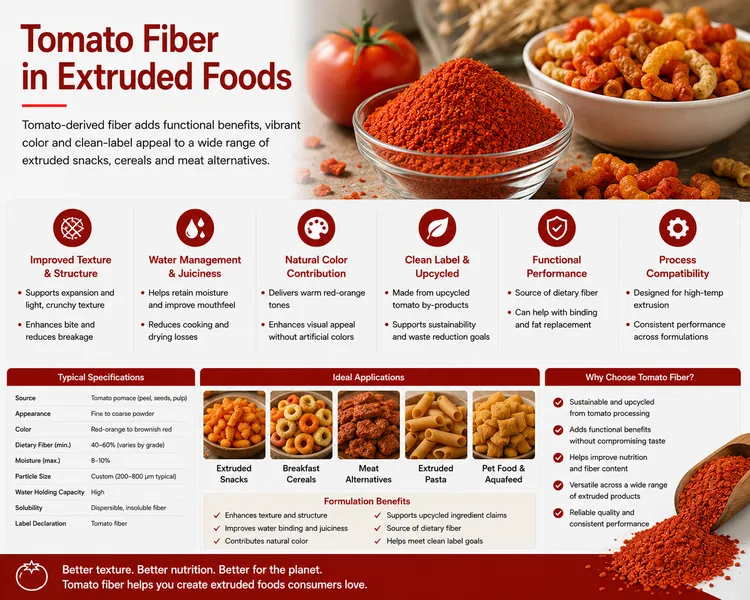
Tomato ingredients can contribute color, acid balance, savory depth, sauce adhesion and moisture management around protein systems. Tomato-derived fiber adds another functional dimension because it can influence water distribution and texture while also providing a tomato-origin ingredient story.
In extruded foods, relatively small formulation changes can affect feed consistency, expansion, density, surface appearance and finished bite. A tomato fiber therefore needs to be evaluated as part of the complete extrusion system rather than treated as a simple one-for-one dry ingredient substitution.
Ingredient selection
Match the tomato format to the process: paste or powder for concentrated flavor, puree for sauce systems, and co-products only where suitability and safety are specifically established. For this topic, a logical first ingredient to evaluate is tomato fiber.
Treat that as a formulation hypothesis rather than a fixed rule. The best ingredient is the one that meets the finished-product texture, processing, sensory and cost targets while remaining available with consistent specification and documentation.
Water management is central
Fiber can change how water is distributed through the extrusion feed. If the formulation is adjusted without accounting for this behavior, the material entering the extruder may become too dry, too wet or less consistent than the control.
During development, record both formula water and actual process water additions. The useful inclusion level is often the one that delivers the intended functional benefit without creating excessive moisture demand or reducing line stability.
Evaluate interaction with proteins and starches
Extruded systems frequently contain combinations of proteins, starches, flours, salts and fats. Tomato fiber should be assessed within that complete matrix because those ingredients compete for water and influence the structure created during extrusion.
In protein-rich products, monitor whether the fiber changes cohesion, firmness, chew or break characteristics. In starch-based extrudates, expansion, density and crispness may become more important endpoints.
Particle size can affect processing
Fiber particle size and physical form can influence dry blending, hydration and feed consistency. A finer product may distribute differently from a coarser fiber, even when both meet similar compositional targets.
Include particle-size information in the supplier review and observe whether the fiber remains evenly distributed through the premix before extrusion.
Watch expansion and density
For expanded products, added fiber can affect the structure formed as material exits the die. Monitor dimensions, bulk density and internal cell structure rather than judging the product only by flavor or color.
If expansion decreases, determine whether the result can be corrected through formulation moisture, inclusion level or extrusion settings without creating unacceptable changes elsewhere in the product.
Color and flavor contribution
Tomato fiber may contribute a natural reddish or brown-red tone depending on the ingredient and process. Extrusion heat can further change color, so evaluate the ingredient after the complete thermal process rather than from the dry powder alone.
Flavor contribution may be subtle or more noticeable depending on inclusion level. Check tomato character, cooked notes, bitterness and overall savory balance in the finished product, particularly when the base formula has a mild flavor profile.
Upcycled positioning
Tomato-derived fiber may support an upcycled ingredient positioning when it is produced from appropriate tomato processing streams and the supplier can clearly document the ingredient's identity and production process.
Commercial or marketing claims should be reviewed separately from technical suitability. Confirm the supplier documentation needed to support any desired product positioning before incorporating that claim into the commercial concept.
Practical trial method
Assess interactions with salt, proteins, starches, fats and process water. Thermal processing can change perceived acidity, color and texture, so compare candidates after the full extrusion, drying and reheating sequence where relevant.
- Define the finished-product target, including texture, density, color, flavor and any desired fiber or upcycled positioning.
- Collect current technical data and a representative sample from each candidate source.
- Record ingredient lot, specification, moisture, particle-size information and other relevant compositional data.
- Establish a control formula without the candidate fiber or with the currently approved ingredient.
- Add tomato fiber at a controlled inclusion level and record any corresponding adjustment to formula or process water.
- Run a controlled pilot using the intended premix order, extrusion temperatures, screw or equipment settings and throughput conditions.
- Observe feed consistency, pressure or equipment response, die behavior and any unusual processing changes.
- Measure relevant finished attributes such as density, dimensions, expansion, moisture, texture, color, yield and sensory profile.
- Repeat after the relevant drying, thermal treatment, reheating or storage condition.
- Document the approved supplier, inclusion range, process assumptions, specification and change-control triggers.
Record extrusion conditions carefully
A successful trial is difficult to reproduce if only the ingredient percentage is recorded. Capture the process conditions that produced the acceptable result so later scale-up or supplier comparisons use the same baseline.
- Tomato fiber lot and specification
- Inclusion rate
- Premix sequence
- Formula water
- Additional process water
- Extrusion temperature profile
- Screw or equipment settings
- Throughput or feed rate
- Finished density and texture
- Color and sensory observations
Evaluate after drying or reheating
The product leaving the extruder is not always the final eating experience. Drying, frying, baking, hydration or reheating can change texture and flavor, so the tomato fiber should be evaluated after all commercially relevant process steps.
Where the extruded component will later be combined with a sauce or seasoning system, assess that complete product as well. Fiber interactions may influence how sauce or moisture is absorbed during final preparation.
Scale up cautiously
Pilot equipment can behave differently from commercial extrusion lines. Once a promising inclusion level is identified, confirm performance at the production scale before routine commercial use.
During scale-up, compare throughput, process stability, finished texture and moisture with the pilot target. Record any equipment-specific adjustments so they become part of the approved operating condition.
Questions to ask the supplier
- What is the exact product definition and tomato source for this fiber?
- What process is used to produce and dry the ingredient?
- What crop or origin applies to this lot?
- Which moisture, fiber and particle-size parameters are guaranteed versus typical?
- What water-binding or hydration behavior is typical?
- What color and flavor variation should be expected?
- What is the pack configuration, net weight and storage guidance?
- Which food-safety, quality and organic documents are available for this program?
- How are lots identified and traced?
- What documentation is available regarding the tomato-derived or upcycled ingredient source?
- What changes require customer notification?
Define approval around the finished product
Tomato fiber should be approved according to its effect on the actual extruded product rather than on composition alone. A technically consistent fiber can still be unsuitable if it produces excessive density, poor expansion, unwanted color or an unacceptable change in finished bite.
Keep the approved supplier lot, inclusion level, water adjustments, extrusion conditions and finished-product results together in the trial record. This provides a practical reference for future lots and supplier changes.