
Why this matters
Dry tomato ingredients concentrate tomato flavor and color without adding the water load associated with puree or paste. That makes them useful in seasoning blends, soup mixes, snack coatings, instant foods, bakery seasonings and other dry systems where moisture addition needs to remain low.
Once the ingredient is dry, however, particle size, moisture, flowability and dispersibility become central to performance. An apparently small shift in granule size or fines content can change visual appearance, segregation behavior, dosing consistency and the way tomato flavor is distributed through the finished blend.
Why choose tomato granules
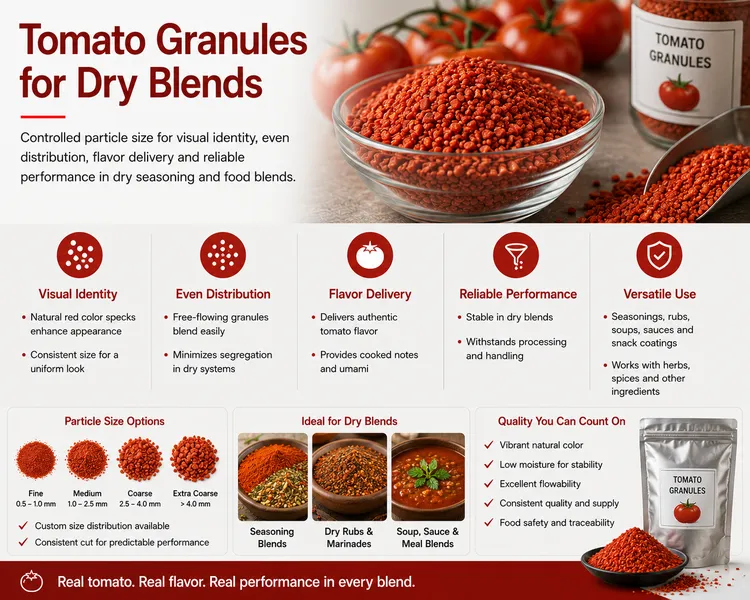
Tomato granules occupy a useful position between fine tomato powder and larger dried flakes or diced tomato. They can provide visible tomato particles while still distributing more evenly through a dry matrix than larger inclusions.
This makes granules particularly useful when the formulator wants the consumer to see a tomato component but still needs reasonably uniform flavor delivery from one serving or package to the next.
Ingredient selection
Select powder when uniform flavor and minimal visible particle identity are the main goals, granules when controlled particle distribution and visible tomato character are desired, and flakes or diced dried tomato when larger visible inclusions are part of the finished-product concept.
For this topic, a logical first ingredient to evaluate is tomato granules. Treat that as a formulation hypothesis rather than a fixed rule: the best answer is the ingredient that meets the finished-product target at an acceptable total cost and with reliable supply.
Particle size is a functional specification
Particle size is not only a visual preference. It affects how tomato granules move through conveying and blending equipment, how easily they separate from other ingredients and how quickly they hydrate during preparation.
A practical specification should therefore describe the target particle-size range and control excessive fines or oversized particles where these could affect product performance. The useful range depends on the other materials in the blend and the intended finished product.
Match particles to the rest of the blend
Dry blends tend to remain more uniform when ingredient particles have reasonably compatible physical characteristics. Large differences in particle size, shape or density can increase the tendency for ingredients to separate during transfer, vibration, shipping or repeated handling.
Evaluate tomato granules in the complete seasoning or dry-food matrix rather than judging them alone. A granule that performs well with salt and sugar may behave differently in a blend containing starches, vegetable flakes, powdered flavors or other particles with very different bulk characteristics.
Control fines
Fine tomato particles can increase color and flavor dispersion, but excessive fines may also increase dusting, change flow behavior or reduce the visible granule effect. For products where appearance matters, monitor the amount of fine material generated both by the supplier and by normal handling.
If granules are fragile, conveying, transfer or aggressive mixing can create additional fines after receiving. Pilot trials should therefore include the actual handling sequence expected in commercial production.
Moisture and flowability
Dry tomato ingredients can pick up moisture during storage and handling. Increased moisture exposure can affect free-flowing behavior, promote clumping and make the material more difficult to dose or distribute consistently.
Review supplier storage guidance and keep packages properly closed after opening. Where the ingredient will be stored in humid environments or held for extended periods after opening, evaluate flowability under conditions that realistically represent plant use.
Evaluate the complete blend
A tomato granule should be evaluated together with salt, sugar, starch, spices, powders and other dry ingredients used in the actual formula. These components can affect flow, color perception, segregation and hydration.
During trials, observe whether the tomato granules remain evenly distributed after blending and after representative handling. If the blend will be packed, shipped or transferred several times, evaluate it after those steps rather than immediately after the mixer stops.
Hydration performance
In products that are later mixed with water or cooked, tomato granules should also be evaluated for hydration. Particle size influences how quickly the tomato softens and releases flavor and color into the surrounding product.
The desired behavior depends on the application. Some products benefit from granules that remain visible after preparation, while others require the tomato component to soften and integrate more fully into the sauce, soup or prepared food.
Color and visual identity
Granules can contribute both overall color and visible red particulate identity. Evaluate the ingredient under the actual finished-product conditions because surrounding ingredients, cooking and hydration can all change the apparent color.
If visible tomato pieces are part of the product concept, define acceptable appearance in practical terms. Supplier samples can then be compared against an approved reference rather than relying only on general descriptions such as "red granules."
Flavor contribution
Dry tomato ingredients can deliver concentrated tomato character, but processing history can influence sweetness, acidity perception, cooked notes and aroma. Compare candidates at an equivalent tomato-solids basis where possible so differences in usage rate do not distort the sensory evaluation.
Evaluate flavor in the complete finished application, not only by tasting the dry ingredient. Salt, fat, seasoning, heat and hydration can change the way tomato character is perceived.
Practical trial method
Control addition order and hydration. Tomato granules and powders can pick up moisture, so evaluate flowability after realistic warehouse exposure and in the complete seasoning matrix rather than only in a freshly opened sample.
- Define the finished-product target, including desired tomato flavor, color, particle visibility and prepared-product behavior.
- Collect current technical data and a representative sample from each candidate source.
- Record ingredient lot, moisture information and available particle-size specification.
- Normalize tomato solids or concentration before comparing usage rates where products differ materially.
- Run a controlled bench or pilot blend using the actual ingredient addition order, mixing time and equipment conditions.
- Observe flowability, dusting, visible fines, granule breakage and distribution through the complete dry matrix.
- Take samples from multiple points in the blend where practical to check visual uniformity and ingredient distribution.
- Prepare or cook the finished product according to the intended consumer or plant process and evaluate hydration behavior.
- Measure relevant attributes such as solids, color, yield and sensory profile where they apply to the finished product.
- Repeat the evaluation after realistic storage, shipping or warehouse exposure.
- Document the approved supplier, particle-size range, specification and change-control triggers.
Watch for segregation
A blend can appear uniform directly after mixing and become less uniform during transport or vibration. Differences in particle size and density can cause granules and finer powders to migrate within a package or intermediate container.
If segregation would affect flavor or appearance from serving to serving, include representative movement in the trial. This can be as important as the initial mixing result.
Storage evaluation
Review the ingredient after exposure to the storage conditions expected in the supply chain. Check whether granules remain free-flowing, retain their expected color and aroma and continue to distribute evenly through the dry blend.
Where long storage periods are expected, finished-package evaluation can also help identify whether the complete formula develops caking, uneven distribution or other handling issues over time.
Define the specification around the application
Avoid relying only on a generic dried tomato specification. The attributes most useful for purchasing and quality control should reflect how the granules are actually used.
- Target particle-size distribution
- Limits for excessive fines or oversized particles where important
- Moisture or relevant dry-product controls
- Color and visual appearance
- Expected tomato aroma and flavor
- Flowability and absence of objectionable clumping
- Pack format and storage guidance
- Lot identification and traceability
Questions to ask the supplier
- What product definition, drying process and crop/origin apply to this lot?
- What particle-size range or screen specification applies?
- How are fines and oversized particles controlled?
- Which parameters are guaranteed versus typical?
- What moisture and storage guidance applies to the product?
- How should opened packages be handled?
- What is the pack configuration and net weight?
- Which food-safety, quality and organic documents are available for this program?
- How are lots identified and traced?
- How much normal variation in particle size, color or flavor should be expected?
- What changes require customer notification?
Keep an approved reference
Where appearance is important, retain an approved ingredient or finished-product reference where appropriate. This makes later lot comparisons easier and gives purchasing, quality and supplier teams a common understanding of acceptable granule size and visual character.
Link trial results to the approved supplier specification so future changes in particle size, moisture, pack configuration or processing can be reviewed against the conditions that originally produced acceptable performance.