
Why this matters
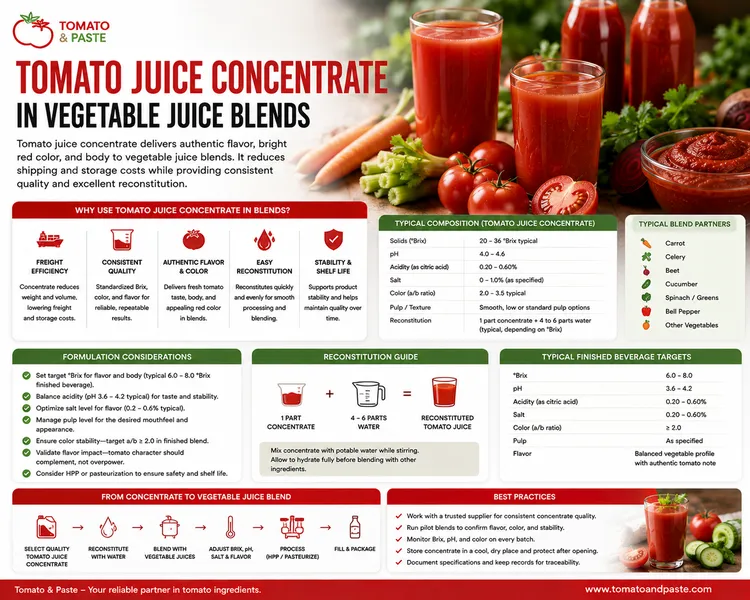
Vegetable juice blends often combine several juices, concentrates, seasonings and water sources into one finished beverage. Tomato juice concentrate can provide efficient tomato flavor, color and solids while allowing the manufacturer to control final dilution at the production site.
Liquid tomato systems require attention to pulp, turbidity, acidity, salt, aroma and suspended-solids behavior in addition to flavor. In a tomato-based formulation, an apparently small change in solids, finish, particle size or process history can alter yield, pumping behavior, sensory profile and the amount of water or stabilization required.
Concentrate also makes formulation discipline especially important. Small differences in incoming Brix or water addition can shift the finished blend away from its intended tomato intensity, drinking body or flavor balance.
Role of tomato juice concentrate
Tomato juice concentrate supplies tomato flavor, color and soluble solids in a reduced-volume format. This can improve freight and storage efficiency compared with shipping the equivalent amount of tomato material as direct-strength juice.
It also gives formulators flexibility to adjust tomato intensity relative to other vegetable components. The final beverage may use tomato as the dominant base or as one element in a more complex blend containing carrot, beet, celery or other vegetable flavors.
Ingredient selection
Choose juice for a direct beverage base, juice concentrate for reconstitution efficiency, puree for additional body, and clear or clarified concentrate for savory intensity with less visible pulp.
For this topic, a logical first ingredient to evaluate is tomato juice concentrate. Treat that as a formulation hypothesis rather than a fixed rule: the best answer is the ingredient that meets the finished-product target at an acceptable total cost and with reliable supply.
Review concentration, pulp level, color, acidity, salt status, flavor, processing history, pack format and storage requirements before approving a source.
Reconstitution control
Reconstitution is one of the central formulation steps when using juice concentrate. The target is not simply to add a fixed amount of water, but to return the concentrate to the intended finished tomato-solids level within the complete beverage.
Record the actual Brix or agreed solids basis of the incoming concentrate and calculate water addition accordingly. If a replacement concentrate has a different concentration, adjust usage so the tomato-solids contribution remains comparable.
Verify the finished batch analytically after blending rather than relying only on theoretical water addition.
Simple solids normalization
When comparing two concentrate suppliers, a weight-for-weight trial may not be meaningful if their Brix values differ. A more concentrated product normally requires a lower usage rate to deliver the same tomato-solids contribution.
Normalize candidate concentrates to equivalent tomato solids before evaluating flavor, color, body and finished yield. This makes it easier to identify real ingredient differences rather than differences caused only by concentration.
Balancing tomato with other vegetable juices
In a multi-vegetable beverage, tomato should be evaluated in the context of the complete blend. Other vegetables may contribute sweetness, earthiness, bitterness, color, aroma or additional suspended solids.
Adjust the tomato concentrate only after defining the intended role of tomato in the finished flavor profile. A tomato-forward beverage may require stronger tomato character, while a balanced vegetable blend may use tomato primarily for body, acidity and savory depth.
Pulp and drinking texture
Tomato juice concentrate may carry suspended pulp that contributes body after reconstitution. This can be desirable, but too much pulp may make the beverage feel heavy or increase visible settling.
Compare candidate concentrates at the same finished dilution and process conditions. Evaluate smoothness, pulp perception and drinkability at the actual serving temperature.
Turbidity and phase stability
Suspended solids from tomato and other vegetable ingredients can create a naturally opaque beverage, but they may also settle over time. Differences in particle size, density, formulation and shear can influence how quickly separation develops.
Evaluate sedimentation, serum separation and turbidity immediately after production and again throughout the relevant storage pathway. If the finished beverage is intended to be shaken before use, check whether settled material redistributes easily.
Acidity and pH
Tomato juice concentrate contributes natural acidity to the blend. Other vegetable ingredients and added acids can change both the measured pH and the sensory perception of acidity.
Measure the complete finished beverage rather than assuming that the tomato concentrate alone determines the final acid balance. Sensory evaluation should also confirm that the beverage tastes bright and balanced rather than harsh or flat.
Salt and seasoning
Confirm whether the incoming concentrate contains added salt. If it does, include that contribution when calculating the finished salt or sodium target.
Salt can also modify the perceived intensity of tomato, acidity and other vegetable flavors. Supplier substitutions should therefore be evaluated in the fully seasoned blend.
Color in vegetable blends
Tomato concentrate can contribute substantial red color, but the final appearance depends on the complete vegetable system. Carrot, beet and leafy vegetable components can shift hue and darkness even when tomato concentration remains constant.
Compare candidate tomato concentrates in the complete formulation after heat treatment. Use the same dilution, lighting, sample depth and storage age when assessing visual differences.
Flavor and aroma
Concentration and processing history can influence tomato aroma and cooked flavor. Because beverage formulations may contain less masking from fat or heavy seasoning than sauces, small flavor differences can be noticeable.
Evaluate the concentrate after reconstitution and again in the complete vegetable blend. Taste the product after the intended thermal process and at the normal serving temperature.
Thermal processing
Heat treatment can affect flavor, color, aroma and physical stability. A concentrate that performs well in an unprocessed bench blend may behave differently after commercial heating and cooling.
Pilot work should reproduce the intended process as closely as practical. Record heating temperature, hold time, cooling conditions and any homogenization or other shear applied before filling.
Mixing and order of addition
Concentrates require adequate mixing to achieve uniform dilution. Addition order can also influence how acids, salts, vegetable solids and other ingredients disperse into the system.
Use the same addition order and mixing conditions when comparing suppliers. If one sample receives substantially more shear or mixing time, the difference may affect pulp distribution and physical stability independently of the ingredient itself.
Processing and filling behavior
The blend must remain manageable through tanks, pumps and fillers. Excessive pulp or body can affect flow, while foaming or phase separation during holding may cause inconsistent filling.
During plant trials, record pumping behavior, tank uniformity, foaming, fill consistency and any visible settling before packaging.
Practical trial method
Evaluate the ingredient at final serving dilution and after the intended heat treatment. Measure sedimentation or phase separation over the expected shelf-life pathway.
- Define the finished vegetable-blend target, including tomato contribution, total solids, pulp, acidity, salt, color, flavor and drinking texture.
- Collect current technical data, specifications and representative samples from each candidate source.
- Record the Brix or solids concentration of each tomato juice concentrate.
- Normalize candidate ingredients to equivalent tomato solids before comparing usage rates.
- Calculate and record the water required for the intended reconstitution.
- Confirm whether the concentrate contains added salt and include it in the formula balance.
- Run a controlled bench or pilot batch using the actual vegetable blend, addition order and mixing conditions.
- Measure relevant attributes such as Brix/solids, pH, color, viscosity or flow and finished yield.
- Evaluate tomato flavor, overall vegetable balance, pulp, turbidity and drinking texture.
- Repeat the evaluation after the intended thermal process and cooling cycle.
- Review sedimentation, phase separation, flavor and color after the relevant storage period.
- Document the approved supplier, specification, reconstitution basis and change-control triggers.
What to compare between supplier samples
- Concentrate Brix / solids
- Reconstitution ratio
- Tomato flavor intensity
- Pulp level
- Color
- pH / acidity
- Salt contribution
- Drinking body
- Turbidity
- Sedimentation
- Phase separation
- Post-process flavor
- Finished yield
Questions to ask the supplier
- What product definition, process and crop/origin apply to this lot?
- What Brix or solids range is guaranteed?
- What reconstitution basis does the supplier recommend for application trials?
- How is pulp or suspended-solids character defined or controlled?
- Does the product contain added salt, and what specification applies?
- What pH or acidity range is specified?
- Which color parameters are guaranteed versus typical?
- What sensory or flavor requirements apply?
- What is the pack configuration, net weight and storage guidance?
- What shelf life applies under the recommended storage conditions?
- Which food-safety, quality and organic documents are available for this program?
- How are lots identified and traced?
- What changes in crop origin, process, concentration, specification or packaging require customer notification?
Commercial evaluation
One of the main commercial advantages of juice concentrate is transporting less water. That can improve freight and warehouse efficiency, but the economic comparison should still be based on usable tomato solids and finished-beverage yield.
Compare delivered cost, concentration, actual usage rate, water addition, pack efficiency, processing requirements, finished yield and supply reliability rather than ingredient price alone.