
Why this matters
Vegetable beverages need to deliver consistent flavor and appearance while remaining easy to drink, fill and store. Tomato ingredients often provide the main liquid base, so differences in concentration, pulp, acidity, salt and process history can noticeably affect the finished beverage.
Liquid tomato systems require attention to pulp, turbidity, acidity, salt, aroma and suspended-solids behavior in addition to flavor. In a tomato-based formulation, an apparently small change in solids, finish, particle size or process history can alter yield, sensory profile, filling behavior and the amount of dilution or stabilization required.
For this reason, supplier comparisons should be made at the intended serving dilution and after the actual thermal process rather than only by tasting the incoming ingredient at its delivered concentration.
Role of tomato juice in vegetable beverages
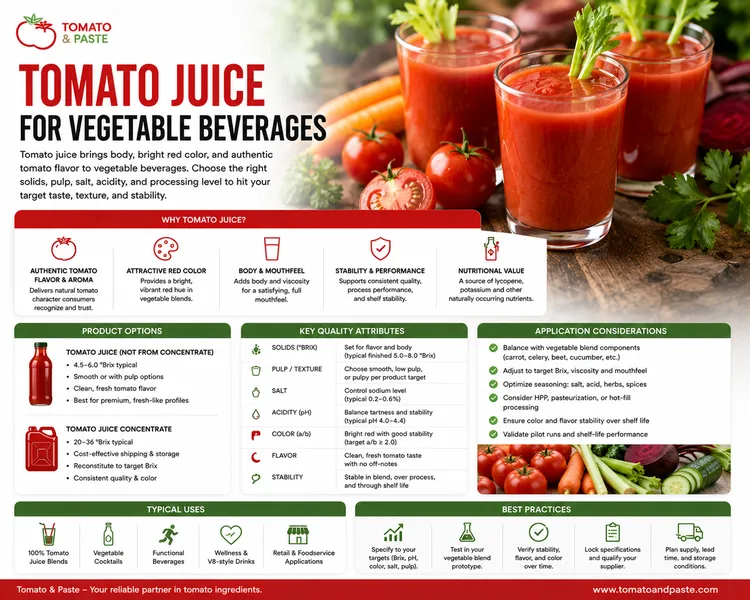
Tomato juice can provide a ready beverage base with natural tomato flavor, color, soluble solids and suspended pulp. It may be used alone or blended with other vegetable juices, seasonings, salt, acids and flavor components depending on the product concept.
The ideal ingredient should support a clean tomato character without creating excessive sediment, thickness or cooked flavor after processing and storage.
Juice versus juice concentrate
Tomato juice can simplify formulation when the desired solids level is already close to the finished beverage target. Juice concentrate can improve shipping and storage efficiency because the manufacturer adds some of the required water at the production site.
When concentrate is used, reconstitution should be controlled carefully. Differences in incoming Brix or solids influence the amount of concentrate and water required to reach the same finished beverage composition.
Ingredient selection
Choose juice for a direct beverage base, juice concentrate for reconstitution efficiency, puree for additional body, and clear or clarified concentrate where savory tomato intensity is wanted with less visible pulp.
For this topic, a logical first ingredient to evaluate is tomato juice or juice concentrate. Treat that as a formulation hypothesis rather than a fixed rule: the best answer is the ingredient that meets the finished-product target at an acceptable total cost and with reliable supply.
Review Brix or solids, pulp level, color, acidity, flavor profile, salt status, processing history, packaging and storage requirements before approving a source.
Managing tomato solids
Tomato solids influence body, yield, flavor intensity and visual opacity. A beverage that contains too little tomato solids may taste thin or weak, while excessive solids can create an overly heavy drinking texture.
Normalize supplier samples to equivalent tomato solids before making sensory comparisons. This prevents a more concentrated ingredient from appearing stronger simply because more tomato material is present in the test.
Pulp and mouthfeel
Suspended tomato pulp contributes body and characteristic tomato mouthfeel, but the preferred amount depends on the beverage style. Some products are designed to feel substantial and pulpy, while others require a smoother, more fluid profile.
Evaluate pulp visually and sensorially after processing. Particle structure can change under pumping, homogenization or other shear, so incoming appearance alone may not predict the final beverage.
Sedimentation and phase separation
Physical stability is especially important in liquid products. Suspended tomato solids may settle during storage, while differences in particle size, density and processing can affect the rate and appearance of separation.
Evaluate candidate ingredients at the intended finished concentration and package format. Record sediment, serum separation or other phase changes immediately after production and at appropriate points during the expected shelf-life pathway.
If shaking before consumption is part of the product concept, also evaluate how easily settled material redistributes and whether the beverage returns to a uniform appearance.
Salt management
Salt can be part of the incoming tomato ingredient or added separately during beverage formulation. Confirm whether the supplied juice or concentrate contains added salt and account for that contribution when setting the finished sodium and flavor target.
Supplier changes should trigger a review of both analytical specification and recipe addition. A difference in incoming salt level can alter flavor balance even when tomato solids remain constant.
Acidity and flavor balance
Tomato contributes natural acidity, but vegetable beverages may also contain added acids or acidic vegetable components. The finished flavor should balance brightness, savory character, salt and any spice or vegetable notes without becoming harsh or flat.
Measure pH according to the product's technical requirements and evaluate sensory acidity at the intended serving temperature. The same analytical result can still be perceived differently depending on salt, tomato solids and the rest of the flavor system.
Color and visual quality
Tomato juice usually provides the dominant red color in the beverage. Other vegetable juices, spices and processing conditions may shift the finished appearance toward orange, brown, purple or darker red tones.
Compare candidate tomato ingredients in the complete beverage after thermal processing. Use consistent lighting, sample depth and storage age when visual color is an important product attribute.
Flavor and aroma
Beverage applications can expose subtle flavor differences more clearly than strongly seasoned sauces or ready meals. Raw tomato character, cooked notes, acidity and aroma therefore deserve careful sensory evaluation.
Taste samples at final serving dilution and after the intended heat treatment. A juice concentrate that tastes acceptable before processing may develop a different cooked profile in the packaged beverage.
Heat-treatment considerations
Thermal processing can change flavor, color, aroma and suspended-solids behavior. The relevant process depends on the beverage and packaging system, so supplier comparisons should reproduce the intended commercial heat treatment as closely as practical.
Record temperature, hold time, heating and cooling conditions during pilot work. Comparing samples processed under different conditions makes it difficult to separate ingredient effects from process effects.
Processing and filling behavior
A beverage must perform not only in the glass but also through mixing, pumping and filling equipment. Excessive body or pulp can influence flow and filling consistency, while overly thin systems may not deliver the desired sensory profile.
Where production equipment is sensitive, record pumping behavior, foaming, fill consistency and any visible separation during holding before packaging.
Practical trial method
Evaluate the ingredient at final serving dilution and after the intended heat treatment. Measure sedimentation or phase separation over the expected shelf-life pathway.
- Define the finished beverage target, including tomato solids, pulp, salt, acidity, color, flavor and drinking texture.
- Collect current technical data, specifications and a representative sample from each candidate source.
- Record Brix or concentration and normalize tomato solids before comparing supplier usage rates.
- Confirm whether the incoming ingredient contains added salt and account for it in the formula.
- Prepare each candidate at the intended final serving dilution.
- Run a controlled bench or pilot batch using the real addition order, mixing conditions and process sequence.
- Measure relevant attributes such as Brix/solids, pH, color, viscosity or flow, yield and sensory profile.
- Evaluate pulp level, turbidity, sedimentation, phase separation and ease of redispersion.
- Repeat the evaluation after the intended thermal process and cooling cycle.
- Review color, flavor, sedimentation and separation after the relevant storage period.
- Document the approved supplier, specification and change-control triggers.
What to compare between supplier samples
- Brix / tomato solids
- Pulp level
- Color
- pH / acidity
- Salt contribution
- Tomato flavor & aroma
- Drinking body
- Turbidity
- Sedimentation
- Phase separation
- Post-process flavor
- Finished yield
Questions to ask the supplier
- What product definition, process and crop/origin apply to this lot?
- What Brix or solids range is guaranteed?
- How is pulp or suspended-solids character defined or controlled?
- Does the product contain added salt, and if so, what specification applies?
- What pH or acidity range is specified?
- Which color parameters are guaranteed versus typical?
- What sensory or flavor requirements apply?
- What is the pack configuration, net weight and storage guidance?
- What shelf life applies under the recommended storage conditions?
- Which food-safety, quality and organic documents are available for this program?
- How are lots identified and traced?
- What changes in crop origin, process, specification or packaging require customer notification?
Commercial evaluation
Compare supplier options on finished-beverage economics rather than ingredient price alone. Juice concentrate may improve freight and storage efficiency, while direct juice may reduce reconstitution steps and simplify production.
Include delivered cost, concentration, actual usage rate, water addition, packaging efficiency, yield, process compatibility and supply reliability in the commercial comparison.