
Why this matters
Bulk tomato paste logistics are part of the ingredient cost and supply plan, not a separate afterthought. Pack dimensions, unit weight, palletization and container loading can affect freight efficiency, warehouse handling, unloading and the number of production batches supported by each shipment.
Tomato processing is crop-linked, so commercial resilience depends on planning, specification discipline and realistic logistics. Delays or misunderstandings around packaging and container configuration can interrupt an otherwise technically approved supply program.
In a tomato-based formulation, an apparently small change in solids, finish, particle size or process history can alter yield, pumping behavior, sensory profile and the amount of water or thickener required. Logistics decisions should therefore preserve clear lot identification and prevent unintended mixing of technically different products.
Start with the pack format
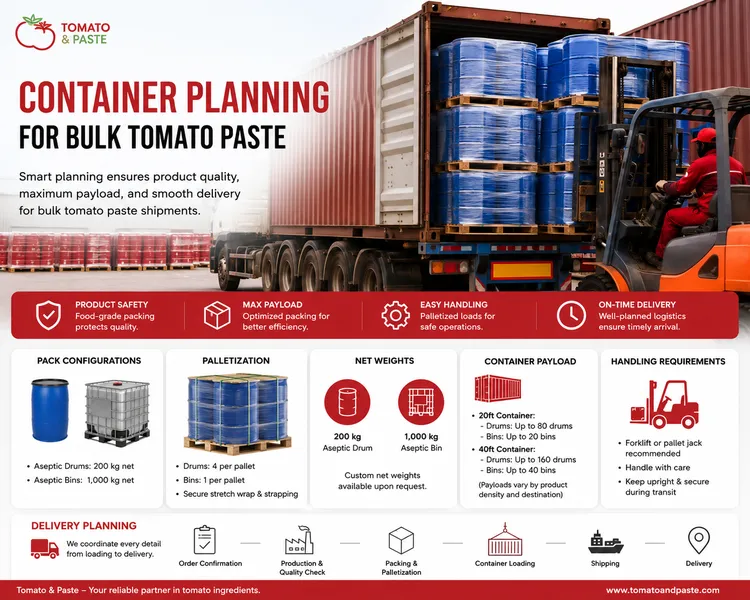
The loading plan begins with the commercial pack. Bulk tomato paste may be supplied in drums, bins or another approved industrial format depending on the processor, customer equipment and regional supply chain.
Confirm the nominal and actual net weight per unit, outer dimensions, pallet requirements and whether the pack can be safely handled by the receiving plant. A packaging option that improves container utilization may still be unsuitable if the customer lacks the required unloading or discharge equipment.
Drums versus bins
Drum and bin configurations can create different tradeoffs in unit handling, warehouse density, production usage and container utilization. The preferred option depends on plant consumption rate, available equipment, storage layout and the supplier's standard packing system.
Smaller individual units may provide more flexibility for production scheduling, while larger units can reduce the number of packages handled per ton of tomato paste. The practical decision should consider both logistics efficiency and plant usability.
Net weight versus gross weight
Container calculations should distinguish product net weight from total gross shipping weight. Gross weight includes the tomato paste plus drums or bins, liners, pallets, protective materials and other packaging components.
Buyers should use the supplier's confirmed loading plan rather than multiplying nominal pack weight by the theoretical number of packages that appear to fit in the container. Physical space and weight limitations can both determine the final load.
Container payload
The commercial objective is usually to use container capacity efficiently without exceeding applicable equipment, road, port or route limitations. A technically possible load at the packing plant may not be practical throughout the complete transport route.
Confirm expected net tomato paste weight per container, total gross cargo weight and the number of drums, bins or pallets before the purchase order and freight booking are finalized.
Palletization
Pallets can simplify warehouse movement and unloading but also consume container space and add tare weight. Some supply programs may use different pallet arrangements depending on destination requirements and customer handling practices.
Confirm pallet material, dimensions, units per pallet, securing method and any destination requirements that apply to wood packaging or other transport materials.
Ingredient selection
Separate must-have technical requirements from negotiable preferences. This creates alternate-source flexibility without compromising critical finished-product attributes. For this application, a logical first ingredient to evaluate is bulk tomato paste in a packaging system compatible with the receiving plant.
The technical specification should still lead the sourcing decision. Solids/Brix, process type, consistency, color, pH/acidity, finish, microbiology and lot documentation should be approved before packaging efficiency is used to compare offers.
Treat the recommended starting point as a sourcing hypothesis rather than a fixed rule. The best answer is the ingredient and pack combination that meets finished-product requirements at an acceptable total landed cost and with reliable supply.
Aseptic packaging considerations
Where tomato paste is supplied in aseptic bulk packaging, the integrity of the liner and outer package is part of shipment quality. Buyers should understand the supplier's pack configuration, handling guidance and procedures for damaged outer packaging.
Receiving teams should also know how the units will be opened, connected, discharged or otherwise handled so that packaging selected during procurement is compatible with actual plant operations.
Warehouse and receiving constraints
Before agreeing on a loading plan, confirm whether the destination can receive and store the proposed unit size and container quantity. Consider dock layout, forklift capacity, pallet dimensions, aisle space, stacking practices and production staging.
If the warehouse routinely receives partial containers or transfers material to another site, additional handling may change the economic comparison between packaging options.
Lot traceability inside the container
A shipment should be easy to reconcile against supplier production lots and accompanying documentation. Confirm whether a container contains one lot or multiple lots and how individual units are marked.
Where multiple lots are loaded, the packing list should provide enough detail for receiving, quality release and later traceability. This becomes particularly important if a complaint or technical investigation affects only part of the shipment.
Loading condition and shipment inspection
Container condition should support protection of the packaged ingredient during transport. Loading practices should reduce unnecessary movement and damage while allowing practical unloading at destination.
Depending on the commercial program, shipment records may include loading counts, lot details, seal information, package condition or photographs. Agree required documentation before shipment rather than requesting it after an issue occurs.
Freight efficiency versus usable solids
Comparing container payload only by gross kilograms can be misleading when candidate tomato pastes have different concentrations. A higher-solids paste may deliver more usable tomato solids within the same physical logistics movement.
Normalize offers to equivalent tomato solids where appropriate, then consider packaging and freight. The useful question is how much approved, usable tomato solids arrive at the destination for the total landed cost.
Practical sourcing and loading method
Compare offers on landed usable solids, approved quality, packaging efficiency, lead time, documentation and continuity—not unit price alone.
- Define the required tomato specification and finished-product attributes that cannot change.
- Confirm the proposed drum, bin or other bulk pack configuration.
- Record net paste weight, gross packaged weight and dimensions per unit.
- Confirm units per pallet and pallets or units per container.
- Request expected net tomato paste payload and gross cargo weight per container.
- Check destination handling, warehouse and unloading compatibility.
- Confirm lot-marking and packing-list requirements for traceability.
- Collect current technical data and a representative sample from each candidate source.
- Normalize tomato solids or concentration before comparing supplier usage rates and freight efficiency.
- Run a controlled bench or pilot batch where a new technical source requires approval.
- Compare total landed cost, lead time, usable solids, pack efficiency and supply continuity.
- Document the approved supplier, specification, pack configuration and change-control triggers.
Container planning checklist
- Pack type and unit dimensions
- Net weight per drum or bin
- Gross packaged weight
- Units per pallet
- Pallet count per container
- Total units per container
- Net tomato paste payload
- Gross cargo weight
- Lot count and traceability
- Receiving equipment compatibility
- Expected shipment lead time
Questions to ask the supplier
- What product definition, process and crop/origin apply to this lot?
- Which technical parameters are guaranteed versus typical?
- What drum, bin or other bulk pack configurations are available?
- What is the nominal and typical net weight per unit?
- What is the gross packaged weight per unit?
- How many units and pallets are normally loaded per container?
- What net product payload and gross cargo weight should be expected?
- What pallet material, dimensions and securing method are used?
- Can a container contain multiple production lots, and how is that documented?
- What storage and handling guidance applies to the packed product?
- Which food-safety, quality and organic documents are available for this program?
- How are individual units and shipment lots identified and traced?
- What changes in product, pack configuration or loading pattern require customer notification?
Commercial evaluation
A container-loading comparison should include more than freight per container. Consider the quantity of usable tomato solids delivered, packaging cost, pallet and handling efficiency, warehouse requirements, unloading labor and any impact on production usage.
A pack configuration with a slightly lower nominal container payload may still be preferable if it improves receiving, reduces handling damage or better matches the customer's production rate. Evaluate the complete landed and operational cost.