
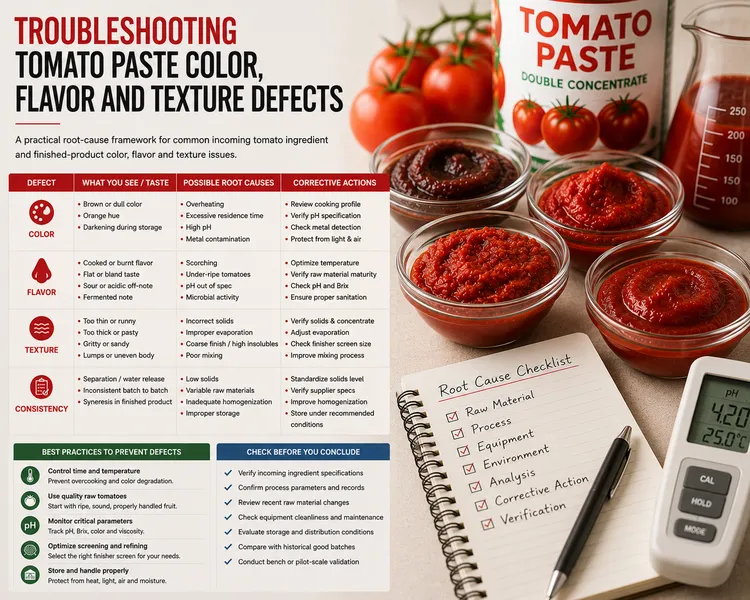
Why this matters
A color, flavor or texture complaint does not automatically mean the tomato paste is defective. Finished-product performance is influenced by the incoming ingredient, formulation, addition order, heat history, shear, storage, analytical methods and the condition of other ingredients in the system.
The specification is the commercial translation of finished-product performance. Normalize comparisons before approving or rejecting a source. In a tomato-based formulation, an apparently small change in solids, finish, particle size or process history can alter yield, pumping behavior, sensory profile and the amount of water or thickener required.
Effective troubleshooting therefore starts by defining the symptom precisely and reproducing it under controlled conditions. The objective is to identify the most likely source of variation before changing the formula, rejecting material or modifying a supplier specification.
Start by defining the defect
Terms such as “too dark,” “off flavor” or “too thin” are useful observations but not complete technical descriptions. Convert the complaint into measurable or repeatable attributes whenever possible.
For color, identify whether the issue is lower redness, excessive darkness, browning, loss of brightness or a difference that appears only after heating. For flavor, describe the character as precisely as possible, such as overly cooked, bitter, metallic, fermented, flat or unusually acidic. For texture, distinguish between low body, high body, graininess, excessive pulp, syneresis, separation or poor pumpability.
Separate ingredient issues from process issues
A useful root-cause investigation compares the suspect lot with an approved reference while controlling the rest of the system. If both materials are processed under different conditions, the comparison cannot reliably isolate the ingredient effect.
Check batch records for differences in addition order, temperature, hold time, shear, water addition, rework, tank residence time and final yield. A process deviation may reproduce the same symptom as an ingredient change.
Check the incoming lot first
Confirm the ingredient identity, supplier lot, production code, pack condition and certificate of analysis before beginning reformulation work. Compare the reported values with the approved specification and with recent accepted lots.
Useful review points can include Brix or concentration, pH or acidity, consistency, color, finish, sensory condition, microbiological requirements, packaging integrity and storage history.
Troubleshooting color differences
Tomato color can be influenced by raw material, processing intensity, concentration, storage and the finished-product formulation. A darker or less vivid result should therefore be investigated at both ingredient and process level.
Compare suspect and reference material at equivalent tomato solids. A more concentrated sample may appear darker simply because more tomato material is present. Then evaluate both samples under the same dilution, lighting, container depth and process conditions.
In finished products, also review heating time, temperature, sweeteners, spices and other dark ingredients because they can change the apparent color independently of the tomato paste.
Troubleshooting flavor differences
Tomato paste flavor is affected by tomato raw material and processing history, but finished-product flavor can also shift because of acid, salt, sugar, spices, fats, flavors and thermal treatment.
Conduct sensory comparisons at equivalent tomato solids whenever possible. Evaluate the paste on its own in a controlled dilution and again in the actual finished formula. A difference that is obvious in diluted paste may be insignificant in the application, while a subtle background note can sometimes become more noticeable after cooking or storage.
Troubleshooting low viscosity or weak body
If a sauce or prepared food becomes thinner than expected, first confirm tomato concentration and actual batch water. Then review the paste consistency, process type, finish, heating profile and any hydrocolloid or starch additions.
Apparent low body can result from lower tomato solids, a different structural profile in the paste, excessive dilution, unexpected shear or a process condition that changes the behavior of the overall thickening system.
Troubleshooting excessive viscosity
Excessive body can create pumping, mixing, filling or dispensing problems even when flavor and color remain acceptable. Confirm that the paste was dosed at the intended concentration and that water additions were correct.
Also review whether the replacement paste provides greater body at equal tomato solids. In formulas containing starches or gums, a paste change may require rebalancing the added thickening system rather than rejecting the ingredient outright.
Troubleshooting graininess or coarse texture
Grainy or coarse mouthfeel may relate to finish, insoluble-solids profile, incomplete dispersion or another particulate ingredient in the formula. Compare the suspect paste with the reference for visible and sensory particle character.
Review downstream shear and mixing as well. A formulation that normally becomes smooth through processing may appear coarse if mixing intensity, homogenization or residence time changes.
Troubleshooting separation or free water
Visible separation may result from the tomato ingredient, but it can also reflect total solids, stabilizer level, acid balance, thermal treatment or the interaction between tomato solids and other formulation components.
Evaluate separation immediately after production and again after the relevant storage period. Record the evaluation temperature and hold time because structure can continue to change after cooling.
Ingredient selection
Start with solids/Brix and process type, then add consistency, color, pH/acidity, finish, microbiology, package and lot documentation. For troubleshooting-sensitive programs, a logical starting point is tomato paste with defined specifications.
A specification should identify the parameters that matter to the finished product and distinguish guaranteed requirements from typical information. The purpose is not to maximize the number of specification lines, but to control the variables that materially affect manufacturing and consumer performance.
Treat the recommended starting point as a technical framework rather than a fixed rule. The best answer is the ingredient that meets the finished-product target at an acceptable total cost and with reliable supply.
Normalize before comparing lots
Comparing two tomato pastes at the same ingredient weight can create a false conclusion if their concentrations differ. Normalize the comparison to equivalent tomato solids before judging color, flavor, viscosity, yield or texture.
Once concentration is controlled, differences related to process type, finish, color or sensory character become easier to identify. Any subsequent formulation optimization can then be based on the actual performance of the selected ingredient.
Use an approved reference
Where practical, retain a representative approved lot or defined reference standard for troubleshooting. A side-by-side comparison against a known acceptable material is often more useful than comparing a suspect lot only with written specification limits.
Reference samples should be stored appropriately and identified clearly so age or storage damage does not create a misleading comparison.
Practical root-cause method
Use one controlled variable at a time wherever practical. Record enough detail that the investigation can be reviewed by quality, technical, operations and the supplier without relying on memory.
- Define the defect precisely and identify when it first appeared.
- Identify all affected ingredient lots, finished-product lots and production dates.
- Confirm the approved tomato specification and review the suspect lot COA against it.
- Check storage conditions and packaging integrity for the incoming tomato ingredient.
- Review batch records for formulation weights, water additions, addition order, temperatures, shear, hold times and yield.
- Collect a representative suspect sample and an approved reference sample.
- Normalize tomato solids or concentration before comparing the two ingredients.
- Compare Brix/solids, pH, consistency or Bostwick, color and sensory profile using consistent methods.
- Run a controlled bench or pilot batch using the real formula and process conditions.
- Repeat the comparison after the relevant thermal process, cooling cycle and storage condition.
- Document whether the difference follows the ingredient lot, the process condition or another formulation variable.
- Agree corrective action and define any specification or change-control update needed to prevent recurrence.
What to document during the investigation
- Supplier and ingredient lot
- COA and approved specification
- Pack condition and storage history
- Brix / solids result
- pH / acidity result
- Consistency / viscosity result
- Color result or standardized visual comparison
- Sensory description
- Batch weights and water addition
- Process temperature and hold time
- Mixing / shear conditions
- Finished yield
- Post-process and storage observations
Questions to ask the supplier
- What product definition, process and crop/origin apply to this lot?
- Does the suspect lot meet every guaranteed parameter on the approved specification?
- What Brix, consistency, color, pH/acidity and finish results were recorded for the lot?
- Which parameters are guaranteed versus typical?
- Were any process, raw-material or equipment conditions unusual during production?
- Are adjacent production lots available for comparison?
- What is the pack configuration, net weight and storage guidance?
- Which food-safety, quality and organic documents are available for the program?
- How are lots identified and traced through processing and shipment?
- What changes in crop origin, process, specification or packaging require customer notification?
Corrective action and change control
Once the likely root cause is identified, corrective action should address the source rather than only the symptom. That may mean tightening an ingredient specification, adjusting a formulation, changing a processing control, improving storage or updating an analytical method.
If a supplier or ingredient change is approved after investigation, document the acceptable specification and application performance so future lots can be assessed against a clear reference.