
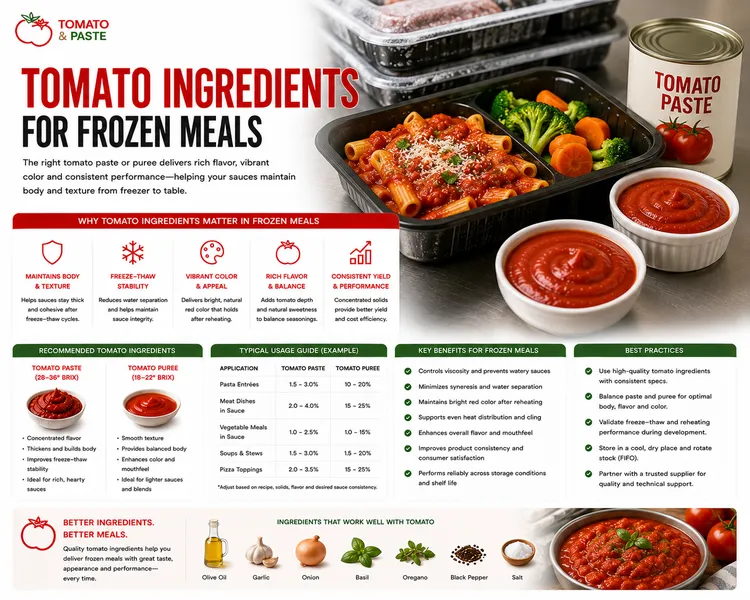
Why this matters
Frozen meals place tomato sauces through several physical changes that do not occur in the same way in freshly prepared products. The sauce may be cooked, filled, rapidly cooled, frozen, stored for an extended period and finally reheated by microwave, oven or another consumer method.
During this cycle, water can redistribute between tomato pulp, vegetables, pasta, grains, proteins, starches and other components. An apparently small change in tomato solids, consistency or pulp structure can therefore affect water separation, sauce body, yield and reheated eating quality.
Why hot break paste is a practical starting point
Hot break tomato paste is a logical ingredient to evaluate where the frozen sauce needs relatively high body and good water-holding performance. Its concentrated tomato solids can help build structure without introducing as much water as less concentrated tomato formats.
This does not make hot break paste an automatic solution to freeze-thaw instability. The complete formula, including starches, vegetables, proteins, fats and process conditions, determines how the final meal behaves after freezing and reheating.
Puree for the continuous sauce phase
Tomato puree can create a softer and more continuous sauce base than paste alone. It can be useful where the product needs a natural tomato texture and enough fluidity for pumping, portioning and coating other meal components.
A paste-and-puree combination can give formulators more flexibility: paste contributes concentrated solids and body, while puree provides water and tomato pulp in a less concentrated format.
Normalize tomato solids
Candidate tomato ingredients should be compared on an equivalent tomato-solids basis when their Brix or concentration differs. Equal usage rates may create misleading results because one ingredient may deliver substantially more solids and less water than another.
Normalize tomato solids first, then adjust process water and the paste-to-puree ratio. This provides a cleaner comparison of viscosity, flavor, color, yield and freeze-thaw performance.
What freezing does to the sauce system
As water freezes, it is temporarily separated from many of the dissolved and suspended solids in the sauce. When the product is later thawed or reheated, that water may not return to exactly the same distribution it had before freezing.
This is why a tomato sauce that looks stable before freezing can show serum separation after reheating. The effect can be influenced by tomato pulp, starch or hydrocolloid systems, vegetable moisture and other formulation components.
Control free water
Excessive free liquid is one of the most visible defects in frozen tomato-based meals. Water may collect around pasta, rice, vegetables or protein pieces and make the finished meal appear diluted.
The tomato system should provide enough solids and structure to integrate the available moisture while still allowing the meal to reheat evenly. Increasing viscosity too aggressively can create an overly pasty sauce, so the target should balance stability with eating quality.
Interaction with vegetables
Vegetables may release additional water during freezing, thawing and reheating. Zucchini, peppers, onions, mushrooms and other high-moisture vegetables can materially change the sauce even if the tomato formula itself remains unchanged.
Evaluate candidate tomato ingredients using the actual vegetable blend and preparation method because raw, roasted, blanched or pre-cooked vegetables can contribute different amounts of available water.
Interaction with pasta and grains
Pasta, rice and other grains can absorb part of the sauce phase during storage and reheating. If the sauce is too fluid, the finished meal may become watery; if it is too concentrated, the starch component may absorb too much moisture and leave the meal dry.
The correct tomato solids target should therefore be established with the complete starch system rather than with sauce alone.
Interaction with proteins
Meat, poultry, seafood and alternative proteins can release moisture and fat during cooking or reheating. These liquids enter the surrounding tomato sauce and may affect apparent viscosity and separation.
Evaluate the sauce with the intended protein component and cooking history. A sauce that performs well in a vegetable-only test may behave differently around meatballs, ground meat or other protein systems.
Fat and emulsion stability
Oil, cheese or fat released from other meal components can separate from the tomato phase during freezing and reheating. Visible oiling-off may change both appearance and mouthfeel.
Check the complete meal after reheating for oil pools, serum separation and uneven coating. Tomato solids can influence the continuous phase, but the overall emulsion system remains formulation-dependent.
Hot and cooled viscosity
Tomato sauce often changes in apparent viscosity as it moves from the kettle to cooled filling conditions. A sauce that looks relatively fluid while hot can become considerably thicker before freezing.
Measure viscosity or Bostwick at standardized temperatures and record the sauce condition at the point where the product is actually portioned into the frozen meal.
Viscosity after reheating
Reheated viscosity may differ substantially from both hot-process and chilled measurements. Starches may continue to hydrate, vegetables may release water and the sauce may concentrate unevenly during microwave or oven heating.
For frozen meals, the reheated consistency should be treated as one of the key approval measurements because it most closely represents consumer experience.
Color stability
Tomato ingredients provide the red color foundation of many frozen ready meals. The selected paste or puree should maintain an acceptable appearance after initial cooking, freezing, frozen storage and reheating.
Evaluate color in the complete product because cheese, oil, meat, vegetables and reheating conditions can all change the visual perception of the tomato sauce.
Flavor after frozen storage
Tomato flavor should remain balanced with herbs, spices, protein and other ingredients after frozen storage. The finished product may experience a different sensory balance from the fresh batch because reheating changes aroma release and concentration.
Compare candidate tomato ingredients after the intended frozen-storage period and consumer preparation method rather than approving them from fresh sauce tasting alone.
Piece integrity
Where the sauce contains diced or crushed tomato, vegetables or other visible pieces, freeze-thaw conditions can soften those components. Pumping, filling and reheating may further reduce piece definition.
Evaluate recognizable pieces after reheating if visible texture is part of the finished product specification.
Ingredient selection
Use high-body tomato ingredients where water separation is a significant risk, and combine concentrated paste with puree where the formula needs both structural body and a smoother continuous sauce phase.
For this topic, a logical first ingredient system to evaluate is hot break paste and puree. Treat that as a formulation hypothesis rather than a fixed rule. The best combination is the one that maintains acceptable body, flavor, color and moisture distribution after the complete frozen-meal cycle at an acceptable total cost.
Practical trial method
Pilot the complete freezing, frozen-storage and reheating sequence. Sauce approval should include the actual meal components and representative package because water migration can occur between components throughout storage.
- Define the finished-product target for sauce body, free liquid, color, tomato flavor and reheated texture.
- Identify attributes that cannot change, such as meal components, package, portion weight, freezing method and reheating instructions.
- Collect current technical data, certificates of analysis and representative tomato samples.
- Confirm Brix or solids, process type, viscosity or Bostwick, color, pH/acidity and finish.
- Normalize candidate tomato products to equivalent tomato solids.
- Define the starting hot-break-paste-to-puree ratio.
- Adjust process water to maintain a comparable solids basis.
- Produce a controlled sauce batch using the actual seasoning, fat and texture systems.
- Measure Brix/solids, pH, hot viscosity or Bostwick, color and batch yield.
- Combine the sauce with the actual pasta, grain, vegetables or protein components.
- Fill into the intended or representative meal package.
- Apply the normal cooling and freezing process.
- Store under representative frozen conditions.
- Reheat using the intended microwave, oven or foodservice preparation method.
- Evaluate free liquid, sauce viscosity, color, flavor, piece integrity and component texture.
- Repeat at relevant frozen shelf-life points.
- Document the approved suppliers, specifications, ingredient ratio and change-control triggers.
What to evaluate in the reheated meal
- Controlled serum and water separation
- Appropriate reheated sauce viscosity
- Good sauce coating and distribution
- Stable tomato color
- Balanced tomato flavor
- Acceptable vegetable or tomato piece integrity
- Minimal undesirable fat separation
- Appropriate pasta, rice or grain hydration
- Stable protein or vegetable texture
- Repeatable finished yield and portion appearance
Freezing rate and product structure
Freezing conditions can influence the way water is distributed within the finished meal. Ingredient trials should therefore use a freezing process that reasonably represents commercial production rather than relying only on an unrelated laboratory freezer condition.
When production freezing equipment or process settings change, confirm that the tomato sauce and complete meal still meet the approved post-reheat specification.
Frozen storage
Evaluation immediately after freezing is not enough for products intended for extended frozen shelf life. Changes in moisture distribution, color, flavor or texture may become more apparent after storage.
Include appropriate shelf-life checkpoints and assess the complete reheated meal at each point rather than evaluating only the frozen package.
Microwave reheating
Microwave preparation can create uneven temperature and moisture gradients. Some areas of the sauce may become more concentrated while other areas receive water released from vegetables, pasta or proteins.
Where microwave instructions are part of the product, use the declared or representative consumer method during development and evaluate stirring behavior if the instructions require it.
Oven reheating
Oven reheating generally applies heat more slowly and may allow greater surface evaporation. This can produce a different sauce consistency from microwave preparation.
If both oven and microwave methods are offered, the tomato system should be validated under both so that neither produces excessive dryness or free liquid.
Cost and formulation yield
Compare tomato ingredients on equivalent tomato solids and reheated finished-meal performance rather than purchase price per kilogram alone. Higher-body paste may allow a lower inclusion rate or reduce the need for other texture adjustment.
Total cost should also consider sauce yield, water adjustment, starch or hydrocolloid use, processing losses, separation-related rework and the commercial impact of poor reheating performance.
Batch repeatability
Frozen-meal programs depend on repeatable tomato solids, consistency, color and flavor across production lots. Supplier qualification should therefore consider commercial-lot consistency rather than only one development sample.
Define which tomato parameters are guaranteed, which are typical and which changes require notification so the manufacturer can establish appropriate incoming controls.
Questions to ask the supplier
- What product definition, process and crop/origin apply to each tomato ingredient?
- Is the paste hot break, cold break or another process style?
- What Brix or tomato-solids range is guaranteed?
- Which viscosity or Bostwick parameters are guaranteed versus typical?
- What color specification applies?
- What pH and acidity ranges are typical or guaranteed?
- What screen finish or particle-size specification applies?
- Which microbiological parameters are included in the specification?
- What pack configuration, net weight and storage guidance apply?
- Which food-safety, quality and organic documents are available for the program?
- How are production lots identified and traced?
- What crop, plant, process or specification changes require customer notification?
Commercial takeaway
Tomato ingredients for frozen meals should be selected for performance after the complete freeze-thaw and reheating sequence. Hot break paste can contribute concentrated body and solids, while puree can create a smoother continuous sauce phase.
Compare suppliers at equivalent tomato solids, use the real meal components and packaging, and evaluate after representative frozen storage and reheating. This provides a stronger basis for moisture control, reheated texture, color, flavor, yield and long-term sourcing approval.