
Why this matters
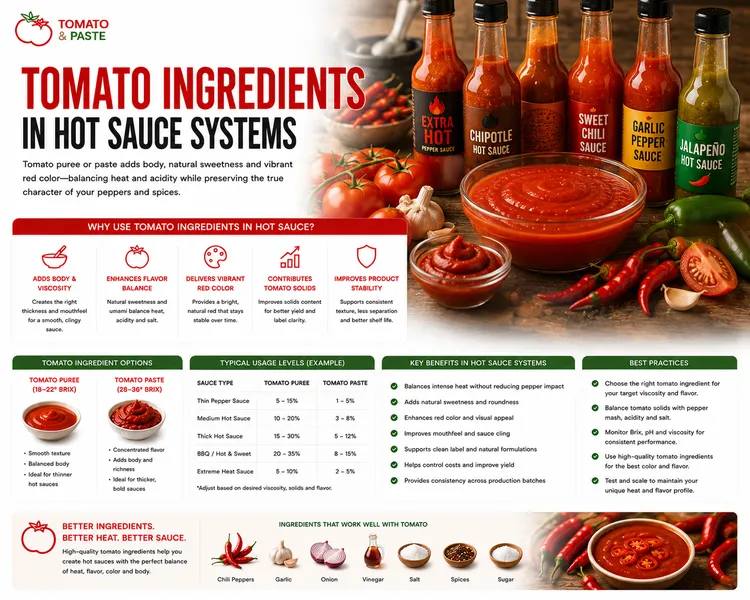
Hot sauce can range from thin, vinegar-forward pepper sauces to thicker table sauces with substantial vegetable and tomato solids. Tomato ingredients are useful when the formulator wants more body, color, natural sweetness or savory depth without relying entirely on starches, gums or added sugar.
Sauce performance is controlled by the interaction of tomato insoluble solids, soluble solids, peppers, water, acid, sugar, salt and thermal or shear history. A relatively small change in tomato concentration or pulp structure can alter viscosity, yield, pepper perception and the amount of water or texture adjustment required.
Decide what role tomato should play
Tomato should be selected according to its intended role in the hot sauce. In some formulas it provides only background body and color; in others it is a major part of the base and contributes a clearly recognizable tomato character.
Defining this role early helps determine whether puree, paste or a combination is most appropriate and prevents the tomato component from unintentionally overwhelming the target pepper profile.
Tomato puree for a softer sauce base
Tomato puree can provide a smooth continuous phase with moderate tomato solids and a relatively natural tomato texture. It is useful where the finished sauce should remain pourable while gaining more body than a primarily vinegar-and-pepper system.
Puree also contributes water, so its inclusion should be considered together with the pepper mash, vinegar and any additional process water.
Tomato paste for concentrated body
Tomato paste delivers more tomato solids per kilogram and can increase body, red color and flavor without adding as much water as puree. It is useful where the sauce needs a concentrated tomato contribution or where final pack volume and yield must be tightly controlled.
Paste can also make the sauce substantially thicker, so it should be balanced against the desired pour rate, bottle opening and dispensing behavior.
Normalize tomato solids
When comparing puree, paste or different paste concentrations, normalize candidate formulas to equivalent tomato solids. Equal usage rates can produce misleading results because the ingredients may contribute very different amounts of water and solids.
Once tomato solids are normalized, adjust water or vinegar as appropriate and compare body, color, pepper expression, flavor and finished yield.
Body and pourability
Hot sauce should have a viscosity that matches its intended package and usage. A table sauce may need enough body to cling to food, while a narrow-neck bottle may require a more fluid product for reliable pouring.
Tomato pulp contributes to body, but pepper solids and any added stabilizers also influence the result. Final viscosity should therefore be evaluated in the complete formulation rather than predicted from tomato Brix alone.
Perceived heat and pepper expression
Adding tomato can change the sensory context in which pepper heat is experienced. Natural tomato sweetness, acidity and solids can make the sauce feel rounder, fuller or less sharply acidic even when the pepper concentration remains unchanged.
Evaluate heat onset, peak intensity, persistence and pepper flavor in the complete sauce. The objective is to ensure that tomato supports the intended style rather than unintentionally muting or shifting the pepper character.
Acid balance
Many hot sauces rely heavily on vinegar or another acid component. Tomato ingredients contribute their own acidity, but their main impact may also come from changing the ratio of solids to acid in the finished sauce.
Evaluate the complete pH and acid system according to the actual formulation and process. Sensory perception of acidity should also be checked because tomato solids and sweetness can soften or reshape the impression of sharpness.
Natural sweetness
Tomato contributes naturally occurring soluble solids that can round the flavor of pepper sauces. This may reduce the amount of added sweetener needed in some formulations, although the effect depends on the desired hot sauce style.
Compare sweetness in the finished sauce after heating because processing can change the balance between acid, pepper, tomato and added sugar.
Color contribution
Tomato can strengthen red or red-orange color in sauces based on red chilies or peppers. This can help create a more uniform appearance, particularly where pepper color varies somewhat from lot to lot.
The final shade should be evaluated after thermal processing and storage because both pepper and tomato pigments can change under heat and time.
Pepper color and tomato color together
The tomato ingredient should complement rather than obscure the natural color of the intended pepper variety. A bright pepper-forward sauce may need less tomato color contribution than a thicker red table sauce.
Run color comparisons using the actual pepper source because the same tomato ingredient can appear different when combined with different chili cultivars or pepper mashes.
Flavor integration
Tomato can add savory depth and help connect pepper, garlic, onion, spices and acid into a more rounded sauce profile. At higher inclusion rates, however, it can move the product toward a tomato-chili sauce rather than a pepper-dominant hot sauce.
Sensory trials should define the desired balance explicitly: pepper-forward, balanced pepper-and-tomato, or tomato-led with chili heat.
Hot and cooled viscosity
Sauce viscosity can change as the product cools, especially where tomato paste or other high-solids ingredients are used. Measure consistency at standardized temperatures rather than relying only on appearance during hot processing.
This is particularly important for squeeze bottles or foodservice dispensing systems where small differences in cooled viscosity can affect user experience.
Separation and suspension
Pepper particles and tomato pulp can settle or separate if the continuous phase does not hold them uniformly. Tomato solids can help provide suspension, but the final stability also depends on particle size, shear and any added stabilizer system.
Check the finished sauce after a standardized storage period for serum separation, pepper settling or visible stratification.
Particle size and finish
The desired sauce texture determines whether a fine puree, smooth paste or more textured pepper-tomato blend is appropriate. Particle size also affects pumping, homogenization and bottle filling.
Where a smooth commercial sauce is required, confirm that the tomato finish is compatible with the target texture and the intended processing equipment.
Ingredient selection
Choose tomato puree where a softer, more fluid base is useful and tomato paste where concentrated solids, stronger body and lower water contribution are priorities. A combination can be used when the sauce needs both easy flow and tighter solids control.
For this topic, a logical first ingredient to evaluate is tomato puree or paste. Treat that as a formulation hypothesis rather than a fixed rule. The best choice is the ingredient that supports the desired pepper profile, body, color and total cost with reliable supply.
Practical trial method
Bench trials should normalize tomato solids first, then tune pepper, acid, water, sugar and salt. Final approval should reproduce the actual thermal and shear process because those conditions can affect pepper aroma, sauce viscosity, color and separation.
- Define the target hot sauce style, including pepper intensity, heat level, tomato character, body, color and pourability.
- Identify attributes that cannot change, such as pepper source, acid system, packaging or declared ingredient profile.
- Collect current technical data, certificates of analysis and representative samples from each tomato candidate.
- Confirm Brix or solids, process type, consistency, color, pH/acidity and finish.
- Normalize tomato solids before comparing candidate usage rates.
- Adjust water or other liquid so trials begin from a comparable solids basis.
- Run a controlled bench or pilot batch using the actual pepper mash, puree or concentrate.
- Use the real acid, salt, sugar and seasoning system.
- Replicate the intended addition order, mixing, homogenization and heat treatment.
- Measure Brix/solids, pH and viscosity or Bostwick where relevant.
- Evaluate pourability or dispensing through the intended package opening.
- Evaluate pepper aroma, heat intensity, tomato contribution, acidity, sweetness and savory balance.
- Check color and visible separation after cooling.
- Repeat evaluation after representative packaged storage.
- Document the approved supplier, specification, tomato usage rate and change-control triggers.
What to evaluate in the finished hot sauce
- Target pepper heat and aroma
- Appropriate tomato contribution
- Balanced acidity and sweetness
- Desired body and pourability
- Stable red or red-orange color
- Minimal serum separation
- Good pepper-particle suspension
- Consistent pH and solids
- Reliable bottle or pouch dispensing
- Stable sensory profile during storage
Processing and homogenization
Hot sauce may be milled, blended or homogenized to achieve a consistent texture. These operations can change particle size and apparent viscosity, so ingredient comparisons should use similar shear conditions.
Excessive processing may also flatten some fresh pepper characteristics. The process should therefore achieve the necessary physical stability without unnecessarily changing the desired sensory profile.
Thermal processing
Heating can develop tomato flavor while reducing fresh pepper aroma. Time and temperature should therefore be considered part of the flavor design, not simply a downstream manufacturing step.
Compare candidate tomato ingredients after the same representative heating conditions so differences in cooked flavor and color are meaningful.
Packaging and dispensing
Sauce viscosity should be compatible with the intended bottle, squeeze package, sachet or foodservice dispenser. Thick sauces may require a wider opening, while thinner products need enough structure to avoid uncontrolled pouring.
Include the actual or representative package in final trials where possible, especially when the product has a narrow dispensing target.
Cost and formulation yield
Compare tomato puree and paste according to equivalent tomato solids and finished-sauce performance rather than purchase price per kilogram alone. Concentrated paste may require a lower usage rate, while puree may reduce dilution steps or produce a softer texture.
Total formulation cost should include tomato usage, water or acid adjustment, processing, yield, packaging compatibility and any added stabilizer or thickener needed to reach the same target.
Questions to ask the supplier
- What product definition, process and crop/origin apply to this tomato ingredient?
- Is the product puree, paste or another tomato format?
- What Brix or tomato-solids range is guaranteed?
- Which consistency parameters are guaranteed versus typical?
- What color specification applies?
- What pH and acidity ranges are typical or guaranteed?
- What screen finish or particle-size specification applies?
- What process type applies to the paste or puree?
- Which microbiological parameters are included in the specification?
- What is the pack configuration, net weight and storage guidance?
- Which food-safety, quality and organic documents are available for the program?
- How are production lots identified and traced?
- What crop, plant, process or specification changes require customer notification?
Commercial takeaway
Tomato ingredients can be useful tools in hot sauce formulation when the goal is to add body, color, sweetness or savory depth without losing the intended pepper identity. Puree can provide a softer base, while paste can deliver concentrated solids and stronger body.
Compare candidates at equivalent tomato solids, use the actual pepper and acid system, and evaluate after complete processing and storage. This provides a stronger basis for consistent heat perception, texture, color, yield and long-term sourcing approval.