
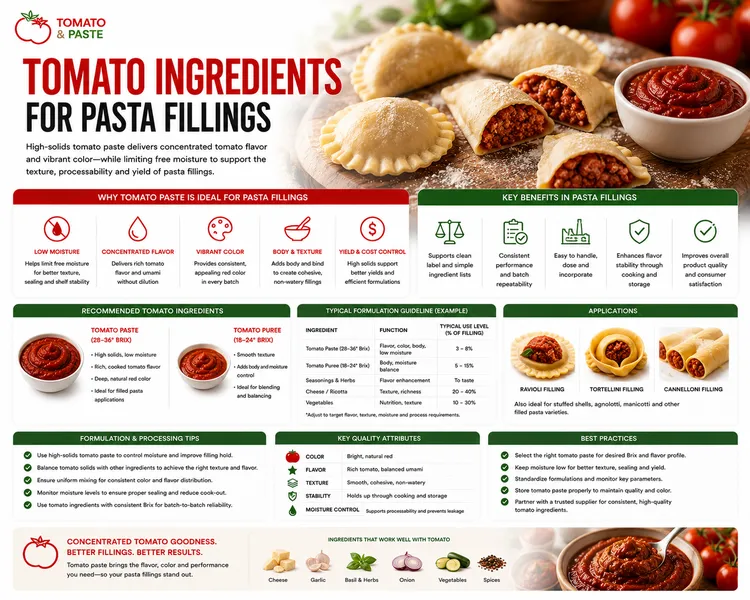
Why this matters
Filled pasta products such as ravioli, tortellini and similar formats require fillings that are flavorful but sufficiently controlled in moisture and texture to run through forming and depositing equipment. Tomato ingredients can provide concentrated color, acidity and savory flavor, but they also contribute water that must be included in the overall filling balance.
Tomato ingredients in prepared foods must perform through mixing, depositing, forming, cooking, chilling or freezing, storage and consumer reheating. An apparently small change in tomato solids, consistency or process history can alter filling firmness, depositor behavior, final yield and the amount of starch, cheese, breadcrumbs or other binding ingredients required.
Why high-solids tomato paste is a practical starting point
High-solids tomato paste is often useful in pasta fillings because it provides concentrated tomato flavor and color without introducing as much water as puree or less concentrated tomato products. This gives the formulator greater control over moisture while still delivering a recognizable tomato contribution.
The preferred concentration depends on the complete filling system. Cheese, vegetables, meat, plant proteins, breadcrumbs, starches and oils all change the way moisture is distributed and the texture required for reliable depositing.
Control free moisture
Free moisture is one of the key variables in filled pasta. A filling that is too wet may spread excessively, leak during forming, soften the dough locally or become difficult to portion accurately. It may also release liquid during cooking, storage or reheating.
Concentrated tomato paste can help limit water addition compared with a puree-led system, but the whole recipe must still be balanced. Moisture contributed by ricotta, vegetables, meat, oil emulsions and other ingredients should be considered together with the tomato component.
Normalize tomato solids
Tomato pastes with different Brix or solids levels should not be compared at the same usage rate without adjustment. A more concentrated paste contributes more tomato solids and less water per kilogram.
Normalize candidate samples to equivalent tomato-solids contribution first. Then adjust the surrounding filling ingredients as necessary so differences in flavor, color, texture and processability can be evaluated fairly.
Filling texture and depositor behavior
A pasta filling must be cohesive enough to retain its shape but flow consistently through the intended depositor or forming system. Tomato paste can increase body, although the final structure is normally created by the complete mixture rather than the tomato ingredient alone.
Evaluate the filling at the actual production temperature because viscosity can change with temperature. A formulation that is easy to mix while warm may become significantly firmer after cooling.
Interaction with cheese-based fillings
Tomato is commonly paired with ricotta and other cheeses in filled pasta. In these systems, tomato acidity, water and solids become part of a protein-rich filling whose texture can change during mixing, storage and cooking.
Evaluate the tomato paste together with the actual cheese system. Check whether the finished filling remains smooth and cohesive and whether any undesirable liquid separation develops during chilled storage.
Vegetable-based fillings
Vegetables such as spinach, peppers, mushrooms and eggplant can release additional moisture, making concentrated tomato ingredients especially useful where the formulator wants tomato flavor without further increasing free water.
Vegetable preparation also matters. Roasting, draining or pre-cooking can substantially change the amount of water entering the filling, so tomato usage should be established using the real vegetable process rather than an approximate bench substitute.
Meat and protein fillings
Tomato paste can provide color, acidity and savory depth in meat or alternative-protein fillings. It should be evaluated in combination with salt, fats, protein binders, seasonings and cooking losses.
The tomato level should support the intended filling identity rather than overwhelm it. A low inclusion may provide background savory depth, while a higher inclusion creates a more clearly tomato-seasoned filling.
Color and flavor
Tomato paste can give fillings a red or orange-red appearance and can reinforce savory flavor. The final shade depends on the other ingredients, particularly cheese, meat, vegetables and spices.
Sensory evaluation should take place after the pasta has been cooked because the dough, filling temperature and cooking water can change the perception of tomato, salt, acidity and seasoning.
Piece size and smoothness
Filled-pasta equipment may place practical limits on particle size. A very coarse filling can interfere with depositing or sealing, while an excessively smooth filling may not deliver the intended culinary texture.
Tomato paste generally contributes fine pulp, but any vegetable, meat or cheese pieces in the formulation should be sized consistently with the depositor and pasta format. Where other tomato formats are considered, their particle size should also be checked against equipment requirements.
Ingredient selection
Use high-body, concentrated ingredients where water separation is risky; combine paste with other tomato formats only where the additional moisture or piece identity supports the finished product.
For this topic, a logical first ingredient to evaluate is high-solids tomato paste. Treat that as a formulation hypothesis rather than a fixed rule. The best answer is the ingredient that provides the required tomato flavor, color and filling performance at an acceptable total cost and with reliable supply.
Practical trial method
Pilot the complete forming, cooking and storage cycle. A filling should not be approved only from a bowl test because depositing, dough contact, cooking and chilled or frozen storage can reveal moisture or texture problems that are not obvious immediately after mixing.
- Define the finished-product target for tomato intensity, filling firmness, moisture, color and piece size.
- Identify attributes that cannot change, such as pasta format, depositor, cheese or protein system, label declaration, thermal process or storage format.
- Collect current technical data, certificate of analysis and representative samples from each tomato candidate.
- Confirm Brix or solids, consistency, color, pH/acidity, process type and screen finish.
- Normalize tomato solids before comparing candidate usage rates.
- Calculate the water contribution of each tomato ingredient.
- Run a controlled filling batch using the actual cheese, meat, vegetable, starch or binder system.
- Use the real addition order, mixing time and mixing temperature.
- Evaluate filling firmness, cohesiveness and visible free moisture before depositing.
- Run the filling through the intended depositor or a representative forming test.
- Check portion accuracy, dough contamination, sealing and filling leakage.
- Cook the filled pasta under representative conditions.
- Evaluate filling texture, tomato flavor, color and moisture release after cooking.
- Repeat after the intended chilled or frozen storage period and reheating method.
- Document the approved supplier, specification, usage rate and change-control triggers.
What to evaluate in the finished filling
- Controlled free moisture
- Cohesive filling texture
- Reliable depositor flow
- Accurate portioning
- Good pasta sealing performance
- Stable tomato color
- Balanced tomato and filling flavor
- Minimal liquid release during cooking
- Stable texture during storage
- Repeatable finished yield
Chilled filled pasta
In chilled products, moisture can migrate between the filling and the surrounding pasta during storage. This may soften the dough or change the filling texture even when the product performs well immediately after manufacture.
Shelf-life trials should therefore evaluate filling firmness, dough integrity and any visible moisture migration throughout the intended refrigerated period.
Frozen filled pasta
Frozen storage adds a freeze-thaw stress to the system. Water distribution may change during freezing and subsequent cooking, potentially affecting the cohesiveness of the filling.
Candidate formulations should be tested after representative frozen storage rather than only before freezing. Check for filling separation, leakage, texture change and flavor retention.
Cooking performance
The finished filling must remain inside the pasta through cooking and retain an acceptable texture when served. Tomato paste may change firmness and moisture distribution, but pasta seal quality, filling volume and cook conditions are also important.
Use consistent cooking conditions when comparing supplier samples. A filling that looks stable before cooking may release moisture or soften substantially once heated.
Cost and formulation yield
Compare tomato ingredients on equivalent tomato solids and finished-filling performance rather than purchase price per kilogram alone. Higher-solids paste can provide more concentrated tomato contribution at a lower inclusion rate.
Total formulation cost should also include any effects on binder demand, filling yield, depositor efficiency, leakage, pasta losses or rework. The best commercial option is the ingredient that delivers consistent filling performance at the lowest effective finished-product cost.
Questions to ask the supplier
- What product definition, process and crop/origin apply to this lot?
- What Brix or solids range is guaranteed?
- Which consistency parameters are guaranteed versus typical?
- What color specification applies?
- What pH and acidity ranges are typical or guaranteed?
- What screen finish or particle-size specification applies?
- What process type applies to the paste?
- Which microbiological parameters are included in the specification?
- What is the pack configuration, net weight and storage guidance?
- Which food-safety, quality and organic documents are available for this program?
- How are production lots identified and traced?
- What crop, plant, process or specification changes require customer notification?
Commercial takeaway
Tomato ingredients for pasta fillings should be selected with moisture control as a central consideration. High-solids tomato paste can deliver flavor, color and tomato solids while giving the formulator greater control over the amount of water entering the filling.
Compare suppliers at equivalent tomato solids, reproduce the actual filling and depositing system and evaluate performance after cooking, storage and reheating. This provides a stronger basis for consistent filling texture, pasta integrity, flavor and production yield.