
Why this matters
Pizza sauce must spread evenly across dough, deliver recognizable tomato flavor and retain the intended texture during baking. It also needs to perform consistently through pumping, mixing, portioning, chilled or frozen storage and application at the pizza line.
Sauce performance is controlled by the interaction of tomato insoluble solids, soluble solids, water, acid, salt, herbs, spices and thermal or shear history. An apparently small change in tomato solids, finish, pulp structure or process history can alter yield, spreadability, bake behavior and the amount of added water or thickener required.
Hot break paste versus concentrated crushed tomato
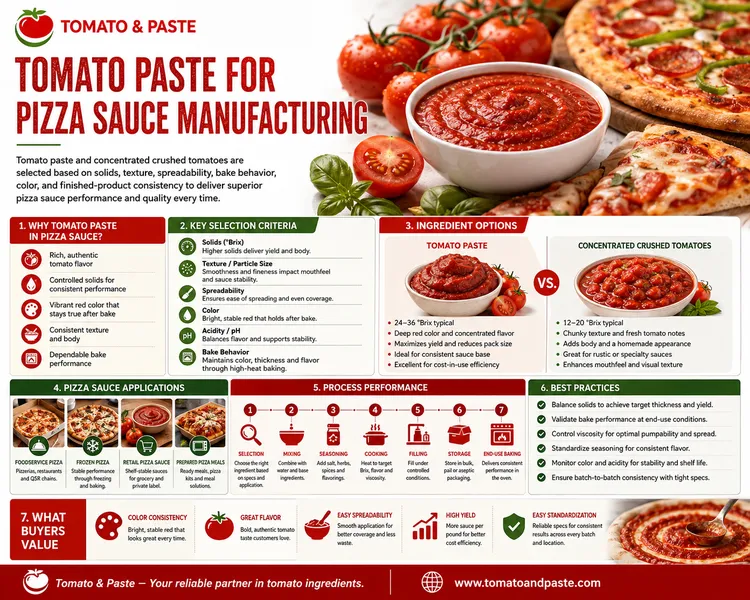
Hot break tomato paste is a practical starting point where the sauce needs strong body, efficient tomato-solids delivery and controlled water release. Its higher-body characteristics can help support a sauce that remains in place after application to the dough.
Concentrated crushed tomatoes can provide more visible pulp and a more textured culinary appearance. They may be preferred for pizza styles where the finished sauce should retain recognizable tomato texture rather than presenting as a completely smooth base.
Solids and reconstitution
Pizza sauce made from concentrated tomato ingredients normally requires controlled water addition. The amount of water should be calculated from the actual solids or Brix of the incoming ingredient rather than from a fixed dilution ratio.
Supplier comparisons are more meaningful when candidate products are normalized to equivalent tomato solids. After normalization, water can be adjusted to achieve the target spreadability and bake performance.
Spreadability on the dough
A pizza sauce should spread with reasonable effort while remaining where it is placed. A sauce that is too thick can be difficult to portion and may tear or drag across soft dough, while a sauce that is too thin can migrate toward the edge or create uneven coverage.
The ideal consistency also depends on application equipment. Manual ladling, automated depositors, pumps and sauce spreaders may each favor a somewhat different viscosity and particle profile.
Water release during baking
Excessive free water can contribute to a wet pizza surface, especially when the formula also contains high-moisture cheese or vegetable toppings. Tomato solids and pulp structure help control the amount of water available during baking.
Evaluate the sauce on the actual pizza rather than only in a cup or laboratory container. Dough type, sauce loading, cheese, toppings, oven temperature and bake time all influence how the tomato phase behaves.
Texture and particle size
Screen finish and particle distribution influence both spreadability and the finished visual style. A fine tomato base can produce a smooth, uniform sauce, while concentrated crushed tomato may provide more rustic texture.
Particle size should also be compatible with pumps, depositors and other sauce-handling equipment. Where herbs or spice particles are present, the complete formulation should pass reliably through the intended line.
Color after baking
Tomato ingredients establish the visual foundation of pizza sauce, but the final appearance should be judged after baking. Heat exposure, cheese coverage, oil migration and toppings can all change the way the tomato color is perceived.
Compare candidate sauces under the same bake conditions. The target may vary from a bright red fresh-style appearance to a deeper cooked red depending on the pizza concept.
Flavor balance
Tomato paste can provide concentrated tomato flavor, acidity and savory depth, while crushed tomato may contribute a softer or more textured tomato profile. The finished balance should work with oregano, basil, garlic, onion, salt and other seasonings rather than being judged from the tomato ingredient alone.
Sensory trials should include the baked pizza because oven heat changes the perception of tomato, herbs, spices, cheese and salt. A sauce that tastes ideal before baking may appear flatter, sweeter or more concentrated after the bake.
Hot and cooled viscosity
Pizza sauce can change structure during preparation and storage. If the sauce is heated during manufacture, measure both hot and cooled consistency because tomato solids and any added texture systems may develop differently as temperature changes.
Define a consistent test temperature and method for supplier comparisons. This improves repeatability when evaluating Bostwick, viscosity or other internal sauce-consistency measurements.
Ingredient selection
Choose a tomato format for the role it must play: paste for concentrated solids and body, puree for a smoother base, crushed tomato for greater texture, or other tomato ingredients where a different flavor or pulp profile is required.
For this topic, a logical first ingredient to evaluate is hot break paste or concentrated crushed tomatoes. Treat that as a formulation hypothesis rather than a fixed rule. The best answer is the ingredient or combination that meets the finished-product target for spreadability, bake behavior, color and flavor at an acceptable total cost and with reliable supply.
Practical trial method
Bench trials should normalize tomato solids first, then tune water and seasonings. Final approval should include application to the actual pizza base and the representative baking cycle rather than relying only on unbaked sauce measurements.
- Define the finished-product target for tomato flavor, solids, texture, spreadability, color and bake behavior.
- Identify attributes that cannot change, such as pizza style, sauce loading, label declaration, seasoning system or application equipment.
- Collect current technical data, certificate of analysis and a representative sample from each candidate tomato source.
- Confirm Brix or solids, process type, consistency, color, pH/acidity and particle finish.
- Normalize tomato solids before comparing usage rates.
- Adjust water so each trial begins at a comparable tomato-solids contribution.
- Run a controlled bench or pilot sauce batch using the actual addition order and seasoning system.
- Use representative mixing and shear conditions.
- Measure Brix/solids, pH, viscosity or Bostwick, color and final yield.
- Evaluate spreadability using the intended manual or automated application method.
- Apply the same sauce weight to representative pizza bases.
- Bake under the intended or representative oven conditions.
- Evaluate water release, sauce coverage, color, flavor and tomato texture after baking.
- Repeat evaluation after the intended chilled or frozen storage condition where relevant.
- Document the approved supplier, specification, usage rate and change-control triggers.
What to evaluate on the finished pizza
- Consistent sauce coverage
- Controlled spread without excessive runoff
- Minimal undesirable free water
- Appropriate tomato body after baking
- Stable red color
- Balanced tomato, herb and spice profile
- Compatible texture with cheese and toppings
- Repeatable portion weight and yield
Foodservice considerations
Foodservice pizza sauce may be stored in bulk containers, pouches or smaller packs and portioned repeatedly throughout service. The sauce should remain sufficiently consistent over the operating period without excessive serum separation or settling.
Where sauce is used cold, evaluate its dispensing behavior at refrigerated or room temperature as appropriate. Temperature can significantly affect perceived viscosity and portion control.
Industrial frozen pizza
Frozen pizza creates an additional performance requirement because the sauce may be applied before freezing and later baked by the consumer. Water can redistribute during freezing, frozen storage and thawing or baking.
Candidate sauces should therefore be evaluated after the full freeze-and-bake sequence. Check whether sauce texture, color and water release remain acceptable after representative frozen storage.
Cooked versus uncooked sauce systems
Some pizza sauces are cooked before application, while others are blended and applied with limited pre-cooking. The preferred tomato ingredient can depend on this process because the pizza oven provides an additional thermal step.
For uncooked or lightly processed systems, incoming tomato flavor and texture can have a particularly direct effect on the finished pizza. For cooked systems, hold time and heat exposure should be controlled during supplier trials.
Cost and formulation yield
Compare candidate tomato ingredients on equivalent solids and finished-pizza performance rather than purchase price per kilogram alone. Higher-concentration paste may require a lower usage rate and greater water addition, while concentrated crushed tomato may contribute different texture and handling characteristics.
Total cost should also consider sauce yield, water adjustment, processing, application losses and any additional thickening required. The most economical ingredient is the one that achieves the required sauce performance consistently at the lowest effective finished-product cost.
Questions to ask the supplier
- What product definition, process and crop/origin apply to this lot?
- Is the ingredient hot break paste, concentrated crushed tomato or another format?
- What Brix or solids range is guaranteed?
- Which consistency or Bostwick parameters are guaranteed versus typical?
- What color specification applies?
- What pH and acidity ranges are typical or guaranteed?
- What screen finish or particle-size specification applies?
- Which microbiological parameters are included in the specification?
- What is the pack configuration, net weight and storage guidance?
- Which food-safety, quality and organic documents are available for this program?
- How are production lots identified and traced?
- What crop, plant, process or specification changes require customer notification?
Commercial takeaway
Tomato paste for pizza sauce should be selected according to both sauce handling and performance on the baked pizza. Solids and viscosity are important, but particle structure, water release, color and flavor after baking also influence the final result.
Compare suppliers at equivalent tomato solids, reproduce the actual sauce application method and evaluate the candidates under representative baking and storage conditions. This provides a stronger basis for consistent portioning, finished-pizza quality and long-term sourcing approval.