
Why this matters
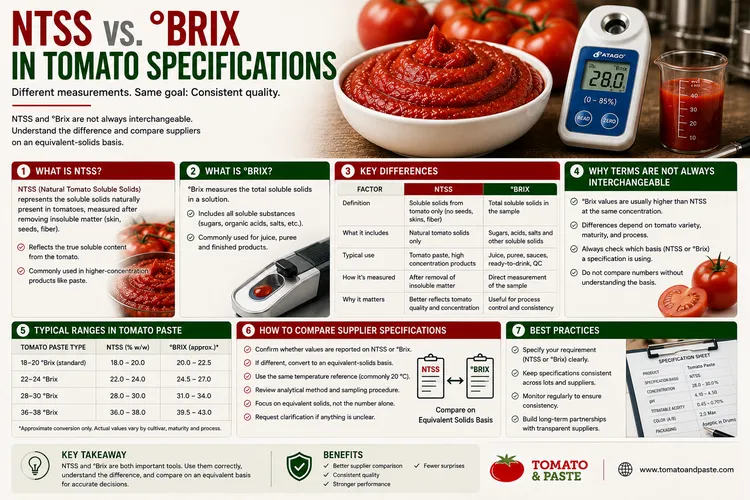
Solids concentration is one of the most commercially important values on a tomato paste specification because it affects ingredient usage, water balance, yield, freight efficiency and the cost of tomato solids in the finished formula. However, technical sheets may describe tomato concentration using terms such as °Brix, soluble solids or NTSS, and those terms should be interpreted carefully before two products are compared.
The specification is the commercial translation of finished-product performance. Normalize comparisons before approving a source. In a tomato-based formulation, an apparently small change in solids, finish, consistency or process history can alter yield, pumping behavior, sensory profile and the amount of water or thickener required.
What does °Brix mean?
°Brix is commonly used as an indication of soluble-solids concentration and is typically determined by refractometry. In a simple sucrose-and-water solution, one degree Brix corresponds approximately to one gram of sucrose per 100 grams of solution. Tomato products are more complex than a pure sugar solution, so the reading reflects the combined refractive effect of naturally occurring soluble tomato constituents rather than sugar alone.
In commercial tomato paste, Brix is widely used as a convenient concentration and purchasing reference. Buyers may encounter paste categories such as roughly 28–30° Brix, 30–32° Brix or 36–38° Brix, depending on the processor, product style and market. The exact contractual definition and analytical method should still be confirmed with the supplier.
What does NTSS mean?
NTSS generally refers to Natural Tomato Soluble Solids. The intention is to express soluble solids originating from the tomato itself rather than automatically counting every dissolved component that may influence a refractometer reading. This distinction becomes especially relevant when a product contains added salt, sugars or other soluble ingredients, or when specifications from different markets use different calculation conventions.
For plain industrial tomato paste with no added soluble ingredients, NTSS and the reported Brix value may be close enough for many commercial discussions. They should nevertheless not be assumed to be mathematically identical unless the supplier's specification, analytical method and product composition confirm that interpretation.
Why NTSS and °Brix can differ
A refractometer responds to dissolved material that changes the refractive index of the sample. Tomato naturally contains sugars, organic acids, minerals and other soluble compounds. If additional soluble ingredients are present, they may also influence the observed reading. NTSS terminology is therefore useful when a buyer needs to distinguish the concentration contributed specifically by tomato from the broader soluble-solids reading of the finished ingredient.
Differences can also arise from analytical procedure, sample preparation, temperature compensation, instrument calibration and the exact calculation used by the processor. For procurement purposes, the key question is not simply which number is larger, but whether both suppliers are reporting the same parameter using an equivalent method.
How to compare supplier specifications
Do not compare one supplier's NTSS value directly with another supplier's °Brix value until the definitions are clear. Ask each supplier to identify the analytical method, whether the value is directly measured or calculated, and whether salt or any other soluble ingredients are present.
Once the basis is understood, convert the commercial comparison into equivalent usable tomato solids. This helps avoid selecting a nominally cheaper paste that requires a higher inclusion rate, produces a different water balance or changes finished-product texture.
Ingredient selection
Start with solids/Brix and process type, then add consistency, color, pH/acidity, finish, microbiology, package and lot documentation. For this topic, a logical first ingredient to evaluate is industrial tomato paste. Treat that as a formulation hypothesis rather than a fixed rule: the best answer is the ingredient that meets the finished-product target at an acceptable total cost and with reliable supply.
Solids concentration alone does not define paste performance. Two tomato pastes at a similar Brix may behave differently because of break process, serum viscosity, pulp structure, screen finish, tomato variety, crop conditions and evaporation history. For sauces, ketchup, soups and prepared foods, those differences can be as important as the headline solids number.
Practical trial method
Run candidate ingredients in the actual formula at equal tomato-solids contribution whenever possible. Keep the remainder of the formula and processing sequence controlled so that differences in flavor, color, viscosity and yield can reasonably be attributed to the ingredient being evaluated.
- Define the finished-product target and the attributes that cannot change.
- Collect the current specification, certificate of analysis and a representative sample from each candidate source.
- Confirm whether the supplier reports °Brix, NTSS or another solids measure and request the applicable test method.
- Check whether salt, sugar or other soluble ingredients are present and whether they affect the stated solids value.
- Normalize tomato solids or concentration before comparing usage rates and ingredient cost.
- Run a controlled bench or pilot batch using the real addition order and process conditions.
- Measure relevant attributes such as Brix/solids, pH, viscosity or Bostwick, color, yield, piece integrity and sensory profile.
- Repeat the evaluation after the relevant thermal process and storage condition.
- Calculate finished-product yield and cost on an equivalent-solids basis rather than ingredient price per kilogram alone.
- Document the approved supplier, specification, analytical basis and change-control triggers.
Example of an equivalent-solids comparison
Consider two pastes offered at different concentrations. If Paste A is supplied at 28% relevant tomato solids and Paste B at 36%, one kilogram of Paste B contributes more tomato solids to the formula. Comparing only the price per kilogram can therefore be misleading. A buyer should calculate how many kilograms of each product are required to deliver the same quantity of tomato solids, then consider freight, water addition, processing behavior and finished-product yield.
This type of normalization is especially useful when evaluating standard versus high-concentration paste or when moving production between suppliers whose specification formats are not identical.
Other specification values to review with solids
Solids should be reviewed together with the parameters that influence application performance. Depending on the product, these may include Bostwick consistency, Howard mold count or other applicable quality measures, pH, titratable acidity, color values, screen finish, black specks, defects, microbiological limits and sensory characteristics.
Processing terminology also matters. Hot-break and cold-break tomato pastes can produce distinctly different viscosity and flavor behavior even at similar concentration. Buyers should therefore avoid treating Brix or NTSS as a complete description of ingredient functionality.
Questions to ask the supplier
- Is the stated concentration reported as °Brix, NTSS or another solids definition?
- Which analytical method is used to determine or calculate the reported value?
- Does the product contain added salt, sugar or any other soluble ingredient?
- Is the specification value a guaranteed range, minimum, target or typical result?
- What product definition, process and crop/origin apply to this lot?
- Is the paste hot break, cold break or another process style?
- Which consistency, color, acidity and microbiological parameters are guaranteed?
- What is the pack configuration, net weight and storage guidance?
- Which food-safety, quality and organic documents are available for this program?
- How are production lots identified and traced?
- What specification or process changes require customer notification?
Commercial takeaway
Treat NTSS and °Brix as specification terms that require context, not as interchangeable labels. For a meaningful sourcing comparison, confirm what is being measured, compare products at equivalent tomato-solids contribution and then validate the candidates in the finished formulation.
The most economical paste is usually not determined by purchase price alone. Concentration, usable yield, process behavior, freight, packaging, consistency and formula adjustments all contribute to the true delivered cost of tomato solids.