
Why this matters
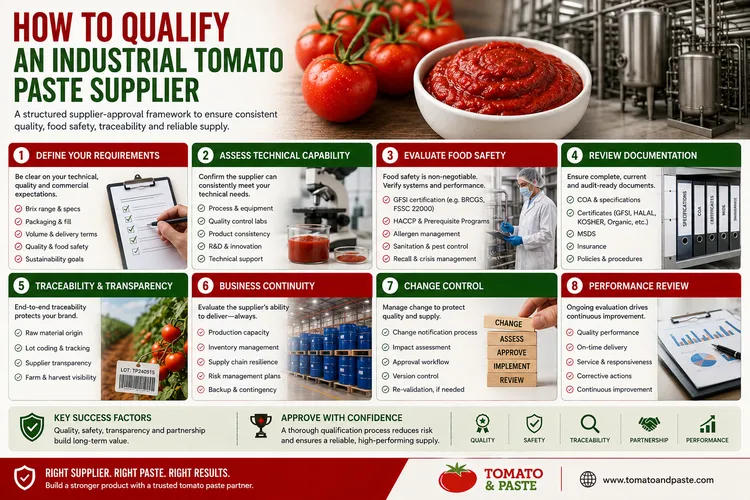
Supplier qualification is more than approving a sample. The objective is to confirm that the processor can repeatedly manufacture tomato paste that meets the required specification, food-safety expectations, documentation standards and delivery commitments over time.
The specification is the commercial translation of finished-product performance. Even relatively small changes in Brix, process type, consistency, finish, color or processing history can alter formulation yield, pumping behavior, sensory profile and the amount of water or thickener required.
Start with a clear product specification
Qualification should begin with a defined product requirement rather than a generic request for “tomato paste.” Establish the target Brix or solids range, process type, consistency, color, pH or acidity, finish, microbiological requirements, pack format and any market-specific documentation.
Separate parameters that are critical from those that are preferences. This helps technical, quality and purchasing teams evaluate alternate suppliers without compromising attributes that materially affect the finished product.
Ingredient selection
Start with solids or Brix and process type, then add consistency, color, pH or acidity, finish, microbiology, packaging and lot documentation. The supplier should be evaluated against the same technical target used by the manufacturing plant.
For this topic, the logical starting point is industrial tomato paste matching the intended specification. Treat the sample as the beginning of the qualification process rather than proof of long-term suitability.
Manufacturing capability
Confirm that the supplier has the equipment, process controls and production scale required for the specification. Ask whether the quoted paste is routinely produced or requires a special campaign.
Review concentration capability, break process, finishing or screening, aseptic filling, packaging formats and normal batch or lot structure. Where tight tolerances are required, understand how the processor monitors and adjusts the relevant parameters during production.
Crop and raw-material management
Tomato processing is closely linked to crop conditions. Supplier qualification should therefore include an understanding of sourcing regions, processing season, crop planning and how the manufacturer manages normal agricultural variation.
Ask whether raw tomatoes are sourced from contracted growers, owned operations or the open market, and how incoming fruit quality is assessed. The objective is not to prescribe a farming model, but to understand how raw-material variability is controlled before processing.
Food-safety systems
Review the food-safety system appropriate to the manufacturing site and intended program. Documentation should be current and should correspond to the facility actually producing the product.
Qualification may include review of hazard controls, sanitation programs, microbiological monitoring, foreign-material controls, allergen management where relevant, pest control, traceability and corrective-action procedures.
Microbiological expectations
Microbiological requirements should be clearly defined between buyer and supplier. Distinguish specification limits from typical values and confirm which tests are performed routinely for release.
If the customer's application requires additional testing or tighter limits, establish this before commercial approval so sampling plans, lead times and certificates can be aligned with the purchase program.
Foreign-material control
Tomato processing involves agricultural raw materials, so supplier qualification should include an understanding of foreign-material control from raw-fruit receiving through finished-product filling.
Ask how the plant manages washing, sorting, screening, magnets or other appropriate controls, equipment condition and line inspections. The required control strategy depends on the process and finished product.
Traceability
Lot coding should allow the supplier to trace finished tomato paste back through relevant processing and raw-material records and forward to affected shipments.
Ask what information is contained in the lot code, how blended or consolidated lots are handled and how quickly the supplier can perform a traceability exercise when requested.
Certificate of Analysis
The Certificate of Analysis should support the agreed specification and provide enough information for the receiving plant to confirm lot identity and relevant release parameters.
Clarify which values are tested on every lot, which are monitored statistically and which are reported as typical rather than guaranteed. A sample COA is useful during qualification because it shows how routine production data will be communicated.
Technical documentation
Build a controlled supplier file containing the current product specification, product description, process information, packaging details, storage guidance and relevant quality or certification documents.
Document version dates and establish a process for reviewing updates. Supplier approval is easier to maintain when both parties know which specification and document versions govern the commercial program.
Organic and program-specific documentation
If the product is sold into an organic or other identity-preserved program, verify the documentation needed for the target market and confirm that the relevant product, processing site and supply chain are covered.
The buyer should also understand how identity is maintained during storage, processing, filling and shipment where program rules require segregation or additional records.
Packaging and aseptic integrity
Industrial paste is often shipped in aseptic bags within drums or bins. Review the exact packaging configuration, liner or bag system, net weight, palletization and storage conditions.
Ask how package integrity is verified during filling, handling and loading. Receiving plants should also define how damaged drums, compromised liners or other packaging deviations are handled.
Storage and shelf life
Confirm the supplier's recommended storage conditions and stated shelf life. Understand whether the quoted material will be shipped from current-season production, carryover stock or another inventory program.
Where long storage periods are commercially important, compare product age with the receiving plant's manufacturing schedule and finished-product requirements.
Sample qualification
A representative sample allows technical teams to screen color, flavor, Brix, pH, consistency and other application-relevant characteristics before a plant trial.
Confirm that the sample represents the quoted commercial product and specification. A highly selected laboratory sample provides limited value if normal commercial lots are produced under different conditions.
Normalize samples before comparison
When candidate pastes have different concentrations, do not compare them automatically at the same usage rate. Normalize the formulation to equivalent tomato solids wherever practical.
This allows viscosity, color, flavor, yield and water demand to be compared more fairly and prevents concentration differences from being mistaken for broader quality differences.
Plant-trial approval
The plant trial should reproduce the real formula, addition order and process conditions as closely as possible. The objective is to confirm whether the supplier's paste performs acceptably in commercial manufacturing, not only in laboratory testing.
Measure the attributes that matter to the application, such as Brix, pH, viscosity or Bostwick, color, yield, pumping behavior, filling performance and sensory profile.
Commercial capability
A technically acceptable supplier must also be able to support the required volume. Review annual production capability, normal minimum order quantities, campaign timing, pack availability and realistic lead times.
Ask how much inventory is normally carried, whether production is primarily made to order and how the supplier manages commitments during a short crop or unusually strong market demand.
Supply continuity
Tomato paste is crop-dependent, so continuity planning should be part of supplier approval. Understand the processor's production season, storage strategy, alternate sourcing options and approach to unexpected crop or logistics disruptions.
Buyers should also decide whether the supplier is intended to be a primary source, an alternate approved source or part of a multi-origin sourcing strategy.
Logistics capability
Review the complete route from plant to destination, including container loading, inland transport, port handling and expected transit time where international shipment is involved.
Confirm whether the supplier or trading partner can provide the commercial and shipping documentation required for the destination and how shipment issues are escalated.
Change control
Supplier qualification should define which changes require advance customer notification. Relevant examples can include manufacturing site, process type, source region, specification, packaging system, formulation aids or other changes that could affect product performance.
Change control prevents a supplier from remaining technically “approved” while the actual product or manufacturing conditions evolve beyond the basis of the original qualification.
Deviation and complaint handling
Ask how the supplier investigates out-of-specification results, packaging issues and customer complaints. A useful corrective-action process should identify the affected lot, investigate probable cause and document preventive steps where appropriate.
Response quality during a deviation can be as important as routine performance because it shows how effectively the supplier manages unexpected events.
Audit readiness
Depending on buyer policy and risk level, qualification may include a remote documentation review, third-party audit review or direct supplier audit. The scope should reflect the importance of the ingredient and existing evidence of control.
Audits are most useful when they confirm how documented procedures are applied in practice rather than acting only as a certificate collection exercise.
Practical qualification method
Use a staged process so technical, quality and commercial approval happen in a logical order. This avoids investing in full-scale trials before obvious documentation or capability gaps are resolved.
- Define the tomato paste specification and identify the parameters that are critical to the finished product.
- Collect the supplier's current technical specification, process information, sample COA, quality documents and packaging details.
- Review manufacturing capability, crop/origin, food-safety systems, traceability, storage and supply continuity.
- Obtain a representative commercial sample and confirm that it matches the quoted product definition.
- Normalize tomato solids or concentration before comparing candidate usage rates.
- Run a controlled bench or pilot trial using the real addition order and representative process conditions.
- Measure Brix or solids, pH, viscosity or Bostwick, color, yield, sensory profile and any relevant process observations.
- Review commercial terms, annual capacity, lead time, packaging, freight and continuity planning.
- Resolve any deviations, documentation gaps or open technical questions before final approval.
- Record the approved supplier, product specification, site, pack format and change-control requirements.
Ongoing supplier monitoring
Qualification should not end when the first shipment is approved. Monitor incoming lots for specification compliance, documentation accuracy, delivery performance and recurring deviations.
Periodic review can include supplier scorecards, updated certificates, complaint history, on-time delivery, lot consistency and confirmation that no unapproved process or specification changes have occurred.
Commercial considerations
Compare approved suppliers on total delivered value rather than unit price alone. Product concentration, formulation yield, packaging efficiency, freight, lead time, technical consistency and supply reliability can all affect total manufacturing cost.
A lower-priced source may offer poor value if it creates frequent adjustments, documentation delays or supply interruptions. Conversely, a higher-priced supplier may justify the difference through stronger consistency, logistics or service. Qualification should provide the information needed to make that tradeoff visible.
Questions to ask the supplier
- What exact tomato paste specification and process type are you quoting?
- Which crop, origin and manufacturing site apply to the program?
- Which parameters are guaranteed versus typical?
- How are Brix, consistency, color, pH or acidity and finish controlled?
- Which release tests are performed on every lot?
- What food-safety and quality certifications apply to the manufacturing site?
- How are microbiological and foreign-material controls managed?
- How are lots identified and traced?
- Can you provide a current specification and sample Certificate of Analysis?
- What is the exact pack configuration, net weight and pallet pattern?
- What storage conditions and shelf life apply?
- What annual production capacity and normal lead time apply to this specification?
- How is inventory managed between processing seasons?
- What is the process for handling deviations and customer complaints?
- Which manufacturing, specification, origin or packaging changes require customer notification?