
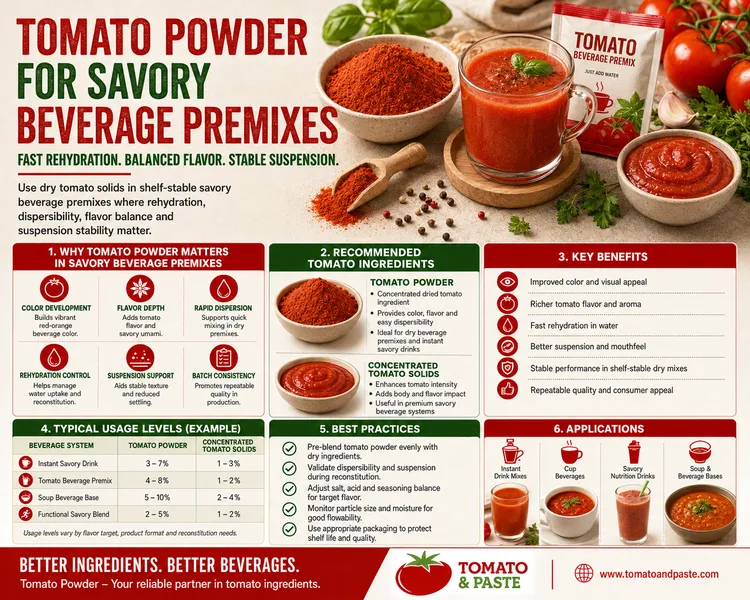
Why this matters
Savory beverage premixes combine the convenience of a dry, shelf-stable format with the sensory expectations of a liquid tomato system. Tomato powder can provide concentrated color, acidity, savory character and tomato solids without requiring the storage and handling of a liquid puree or paste.
In the finished beverage, however, particle size, rehydration rate, suspended-solids behavior, salt balance and flavor become central. Even a modest change in powder specification can alter dispersion, body, sedimentation, color and the amount of mixing needed to prepare a consistent drink.
Ingredient selection
Choose tomato powder where a dry, compact and shelf-stable tomato source is important. Juice or puree may suit directly manufactured liquid beverages, while powder is especially practical for sachets, vending premixes, foodservice bases and other formats that are reconstituted near the point of use.
For this topic, a logical first ingredient to evaluate is tomato powder. Treat that as a formulation hypothesis rather than a fixed rule: the preferred ingredient is the one that delivers the required flavor, color, body, dispersibility and storage performance at an acceptable total cost and with reliable supply.
Rehydration and dispersibility
Tomato powder should disperse predictably when added to the intended volume of water. Fine powders may rehydrate quickly, but some powders can form surface-wetted lumps if they are added too rapidly or mixed with insufficient agitation.
Evaluate the ingredient using the actual preparation instructions. Water temperature, mixing intensity, addition order and standing time can all influence dispersion and should be controlled during supplier comparisons.
Serving dilution
The correct tomato-powder usage rate should be judged at final serving dilution rather than in the dry premix alone. A formulation designed for a concentrated shot, a cup beverage or a larger foodservice serving can require very different tomato-solids levels.
Standardize the powder-to-water ratio during development and record it clearly. Small dilution changes can affect perceived acidity, saltiness, tomato intensity, color and body.
Suspended solids and sedimentation
Reconstituted tomato powder may contain insoluble or slowly settling particles depending on the product definition and processing method. These suspended solids can contribute desirable tomato body, but excessive sedimentation may create an inconsistent drinking experience.
Observe the beverage immediately after preparation and after the expected consumption period. Record visible settling, serum separation and whether gentle stirring or shaking restores a uniform appearance.
Body and mouthfeel
Tomato powder contributes dry solids that influence the body of the finished beverage. The sensory result depends on the powder level, serving dilution and interactions with fibers, starches, gums, proteins, minerals or other functional ingredients in the premix.
Evaluate viscosity at the intended serving temperature. A beverage that appears appropriately fluid when warm may feel heavier after chilling, while a low-solids system can appear thin despite having strong tomato flavor.
Acid and salt balance
Tomato contributes natural acidity together with sweetness and savory character. In a beverage premix, these attributes interact with salt, food acids, spices, vegetable powders, yeast-based flavors and sweeteners.
Taste the beverage after full reconstitution because dry-premix sensory impressions can be misleading. The target should be a balanced finished drink rather than a powder blend that appears correct before dilution.
Color development
Tomato powder can provide the red or orange appearance expected from a savory tomato beverage, but final color depends on serving dilution, powder specification and the opacity created by other ingredients.
Compare candidate powders in the finished beverage using consistent dilution and lighting. Where appearance is a critical product attribute, evaluate color both immediately after preparation and after the normal standing period.
Particle size and dry-blend uniformity
Particle-size compatibility matters in the premix itself. If tomato powder differs greatly in size or bulk density from salt, spices, acids, minerals or other components, the blend may segregate during transport, vibration or filling.
Review particle-size and bulk-density information together with the complete formulation. A homogeneous dry blend supports more consistent tomato concentration from one serving sachet or portion to the next.
Flowability and moisture pickup
Tomato powder can absorb moisture from the surrounding environment. Moisture pickup may cause caking, reduce flowability and make dosing or sachet filling less consistent.
Evaluate the complete premix after realistic storage exposure because other ingredients can also contribute to hygroscopic behavior. Flowability at the end of shelf life can be as important as initial performance.
Interaction with functional ingredients
Savory beverage premixes may include fibers, electrolytes, vitamins, minerals, proteins, botanical ingredients or other functional components. These can change pH, flavor, turbidity, sedimentation and hydration behavior.
Compare tomato-powder candidates in the complete finished formula rather than only in a simplified tomato-and-water system. This helps identify interactions that may not be visible during an ingredient-only screen.
Thermal processing
Some reconstituted beverages are consumed immediately, while others may be heated, hot-filled or subjected to another commercial process before distribution. Heat can change perceived acidity, aroma, color and suspended-solids behavior.
Where thermal treatment is part of the commercial pathway, evaluate the formulation after the actual or representative process rather than relying only on freshly reconstituted samples.
Practical trial method
Evaluate tomato powder at the final serving dilution and under the intended preparation conditions. Keep water ratio, temperature and mixing method consistent so supplier differences can be assessed fairly.
- Define the finished beverage target, including serving size, tomato intensity, body, color, pH and expected preparation method.
- Collect current technical data and representative samples from each candidate source.
- Review moisture, particle size, bulk density, composition and any declared carriers or processing aids.
- Normalize candidate powders to an equivalent tomato-solids or dry-matter basis where appropriate.
- Prepare the complete dry premix using the intended addition order and mixing sequence.
- Reconstitute each sample using the specified water ratio, temperature and mixing method.
- Measure dispersion time, pH, Brix or solids, viscosity, color and sensory profile.
- Observe sedimentation, serum separation and redispersibility over the expected serving period.
- Repeat the evaluation after any relevant thermal process and dry-storage interval.
- Document the approved supplier, specification, inclusion range and change-control triggers.
Packaging and storage
Tomato powder and completed beverage premixes should be protected from unnecessary moisture exposure during storage and distribution. Confirm the supplier's recommended warehouse conditions, pack format and shelf life.
Finished-product shelf-life studies should examine both dry-premix condition and reconstituted performance. Check for caking, flowability loss, color change, flavor drift and any change in dispersion or sedimentation after storage.
Consumer and foodservice preparation
Preparation conditions can differ substantially between single-serve consumer products and foodservice systems. A sachet may be stirred manually in a glass, while a larger premix could be prepared in a dispenser or mixing tank.
Validate the formula at the relevant scale. A blend that disperses well in a laboratory beaker may behave differently in a low-shear vending system or a high-volume foodservice preparation.
Commercial considerations
Compare tomato powders on more than price per kilogram. Moisture, effective tomato-solids concentration, flavor strength, particle size, bulk density, packaging, freight and required inclusion rate can all affect the true cost per finished serving.
A powder that reaches the desired flavor and body at a lower usage rate or disperses more consistently may produce a better total cost outcome than a lower-priced alternative. Final selection should balance sensory performance, preparation convenience, specification consistency, documentation and continuity of supply.
Questions to ask the supplier
- What is the exact product definition and tomato raw material used?
- What process and crop/origin apply to this lot?
- What moisture range is specified?
- What particle-size or mesh distribution applies?
- What is the typical bulk density?
- Does the powder contain carriers, processing aids or other declared components?
- How are color, acidity and flavor consistency monitored?
- What dispersibility and rehydration characteristics should be expected?
- What suspended-solids or sedimentation behavior is typical after reconstitution?
- What storage conditions are recommended to maintain flowability?
- Which parameters are guaranteed versus typical?
- What is the pack configuration, net weight and stated shelf life?
- Which food-safety, quality and organic documents are available for this program?
- How are lots identified and traced?
- What crop, process or specification changes require customer notification?