
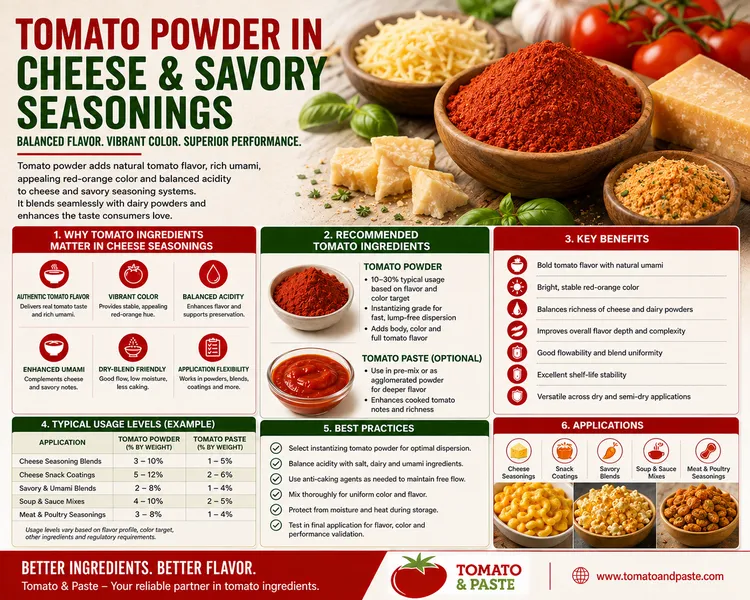
Why this matters
Dry tomato ingredients concentrate flavor and color without adding the water load of puree or paste, making tomato powder useful in cheese seasonings, snack coatings, powdered sauces, prepared-food flavor systems and other savory blends. In these applications, particle size, moisture, dispersibility and flavor intensity can influence both processing and the finished sensory profile.
Tomato powder can bring acidity, sweetness and savory tomato character to dairy-based systems, but even relatively small changes in powder specification can shift the balance between tomato, cheese, salt and other flavors. Supplier samples should therefore be evaluated in the complete seasoning matrix rather than as isolated ingredients.
Ingredient selection
Select powder where uniform tomato flavor and color are required throughout a dry seasoning. Granules can provide a more defined particle distribution, while flakes or larger dried tomato pieces may suit products where visible vegetable identity is desirable.
For this topic, a logical first ingredient to evaluate is tomato powder. Treat that as a formulation hypothesis rather than a fixed rule: the preferred ingredient is the one that meets the required flavor, color, blending, handling and storage targets at an acceptable total cost and with reliable supply.
Balancing tomato with cheese flavor
Tomato acidity and savory character can complement cheddar-style, Parmesan-style and other cheese flavor profiles, but the balance is application-specific. Higher tomato usage can brighten the seasoning and strengthen red-orange color, while lower levels may function mainly as a background savory note.
Evaluate the tomato powder together with the actual cheese powder or dairy flavor system because fat, salt, fermentation notes and dairy solids can change how tomato acidity and sweetness are perceived.
Acidity and savory depth
Tomato powder naturally contributes acidic and savory notes, but the sensory effect depends on the rest of the formula. Added food acids, salt, yeast-based flavors, onion, garlic, spices and sweeteners can either reinforce or mask the tomato contribution.
Build the formula around the desired finished profile rather than assuming tomato powder should provide all acidity or umami on its own. Controlled sensory trials can help determine whether the tomato ingredient is functioning primarily as a recognizable flavor, a color contributor or a supporting savory component.
Color contribution
Tomato powder can shift cheese seasonings toward orange, red-orange or deeper savory tones. The final appearance depends on the tomato-powder inclusion rate as well as the base color of cheese powders, starches, dairy ingredients and other seasonings.
Evaluate color in both the dry blend and the finished application. A seasoning that appears strongly colored in the mixer may look much lighter once applied to a snack surface or diluted into a sauce.
Particle-size compatibility
Particle size influences dry-blend uniformity. If tomato powder is much finer or coarser than cheese powders, salt, spices or other ingredients, the blend may segregate during conveying, filling, transport or storage.
Review the supplier's mesh or particle-size information and compare it with the surrounding ingredients. Reasonably compatible particle distributions can support more consistent flavor and color from one production batch or package to the next.
Moisture and flowability
Tomato powder can absorb moisture from the surrounding environment, and dairy-based seasonings may also contain ingredients that are sensitive to humidity. Moisture pickup can encourage caking, reduce flowability and make automated feeding or dosing less consistent.
Evaluate the complete seasoning blend after realistic warehouse exposure rather than only immediately after mixing. Powder behavior during storage can be as important as initial sensory performance in commercial dry systems.
Interaction with dairy powders
Cheese powders and other dairy ingredients vary in fat level, salt, protein content, moisture and flavor intensity. These factors can influence how tomato powder distributes through the blend and how strongly its acidity and color are perceived.
When changing tomato-powder suppliers, keep the dairy system constant during the first comparison. This makes it easier to isolate the effect of the tomato ingredient before adjusting cheese powder, fat-containing components or supporting flavors.
Fat and flavor release
Many cheese seasonings contain appreciable fat either in the dairy powder itself or in the finished application. Fat can soften acidity and influence flavor release, so tomato intensity should be judged on the actual end product.
Snack coatings, sauces and other prepared foods may deliver the same seasoning blend very differently. Evaluate the seasoning at the intended usage rate and under realistic serving conditions before final approval.
Addition order and blending
Control addition order when producing the seasoning blend. Fine tomato powder should be distributed evenly through higher-volume ingredients to reduce the risk of localized concentration.
Where tomato powder is used at a relatively low rate, a pre-blend can help improve distribution. Commercial validation should use the actual mixer type, batch size, blend time and discharge method intended for production.
Finished-product application
A cheese-and-tomato seasoning should be evaluated on the actual finished product whenever possible. Snack coatings, dry sauce mixes, filled products and ready-meal applications each expose the seasoning to different levels of fat, moisture and heat.
Observe flavor balance, color, adhesion or dispersion and any change after cooking, baking or reheating. The preferred tomato-powder usage rate may differ from the level suggested by tasting the dry seasoning alone.
Practical trial method
Control addition order, blend time and moisture exposure. Evaluate tomato powder in the complete dairy and savory system and then in the intended finished application.
- Define the finished-product target, including cheese profile, tomato intensity, color, salt balance and intended application.
- Collect current technical data and representative samples from each candidate source.
- Review moisture, particle size, bulk density, composition and any declared carriers or processing aids.
- Normalize candidate powders to an equivalent tomato-solids or dry-matter basis where appropriate.
- Prepare the complete seasoning blend using the intended cheese powders, flavors and addition order.
- Evaluate blend uniformity, color, flowability and dry sensory profile.
- Apply or reconstitute the seasoning in the actual finished-product system.
- Evaluate flavor balance, tomato intensity, cheese character, appearance and any process-related changes.
- Recheck flowability, caking and finished-product performance after the relevant storage period.
- Document the approved supplier, specification, inclusion range and change-control triggers.
Storage and packaging
Tomato powder and completed cheese seasonings should be protected from unnecessary moisture exposure during storage and distribution. Confirm the supplier's recommended warehouse conditions, pack construction and shelf life.
Partially used ingredient packs should remain clearly identified by lot and be resealed or protected according to plant procedures. Finished seasoning blends should also be checked for caking, color change or loss of flowability through the intended shelf-life period.
Commercial considerations
Compare tomato powders on more than price per kilogram. Moisture, effective tomato-solids concentration, flavor strength, color, particle size, pack efficiency, freight and required inclusion rate can all influence the real cost of the final seasoning.
A tomato powder that reaches the target flavor and color at a lower inclusion rate may produce a different cost outcome from a less concentrated alternative. Final selection should also consider blending performance, specification consistency, documentation and continuity of supply.
Questions to ask the supplier
- What is the exact product definition and tomato raw material used?
- What process and crop/origin apply to this lot?
- What moisture range is specified?
- What particle-size or mesh distribution applies?
- What is the typical bulk density?
- Does the powder contain carriers, processing aids or other declared components?
- How are color, acidity and flavor consistency monitored?
- What storage conditions are recommended to maintain flowability?
- Which parameters are guaranteed versus typical?
- What is the pack configuration, net weight and stated shelf life?
- Which food-safety, quality and organic documents are available for this program?
- How are lots identified and traced?
- What crop, process or specification changes require customer notification?