
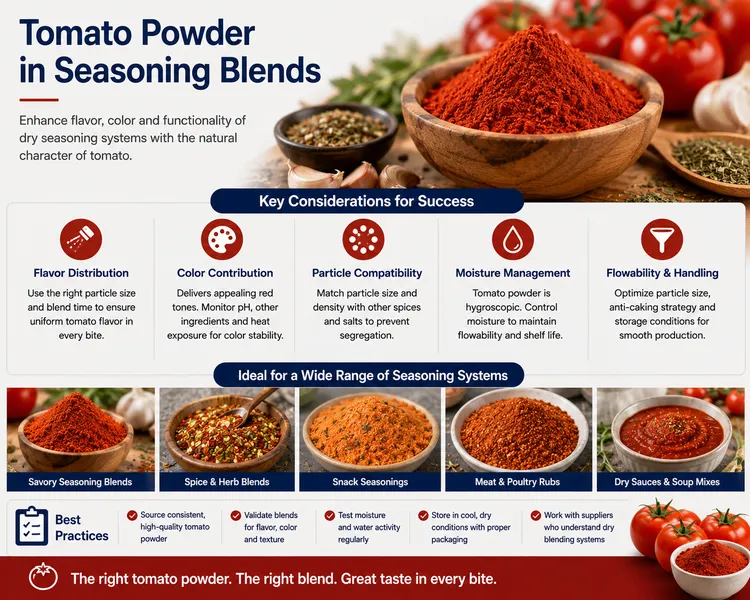
Why this matters
Dry tomato ingredients concentrate flavor and color without adding the water load of puree or paste, making tomato powder useful in seasoning blends for snacks, sauces, soups, prepared meals and other dry systems. In these applications, particle size, moisture, dispersibility and bulk density become important because they influence how evenly the ingredient blends and how consistently the final seasoning can be dosed.
A relatively small change in powder specification can alter color strength, perceived tomato flavor, flow through equipment and the tendency of a seasoning blend to segregate during transport or storage. Evaluating the powder inside the complete seasoning matrix is therefore more informative than reviewing the ingredient by itself.
Ingredient selection
Select powder where uniform flavor and color distribution are important, granules where a more controlled particle distribution is desired, and flakes or diced dried tomato where visible tomato identity is part of the finished product.
For this topic, a logical first ingredient to evaluate is tomato powder. Treat that as a formulation hypothesis rather than a fixed rule: the preferred ingredient is the one that meets the finished-product target for flavor, color, handling and storage performance at an acceptable total cost and with reliable supply.
Particle size and blend uniformity
Particle-size compatibility matters in dry blending. If tomato powder is substantially finer or coarser than salt, spices, starches, dairy powders or other components, the blend may separate during conveying, vibration or storage.
Review the supplier's mesh or particle-size information and compare it with the rest of the seasoning system. A reasonably compatible particle distribution can improve uniformity and reduce the risk that the first and last portions discharged from a mixer differ in composition.
Flavor distribution
Tomato powder can contribute acidity, sweetness, savory character and concentrated tomato notes. The apparent intensity depends on both usage rate and interaction with other seasoning ingredients such as salt, onion, garlic, herbs, chili, cheese powders, acids and sweeteners.
Sensory evaluation should therefore use the complete seasoning formula and, where applicable, the actual finished food. A powder that tastes strong when sampled alone may behave differently once diluted through a complex blend or applied to a product surface.
Color contribution
Color can be an important reason for using tomato powder, particularly when the seasoning itself needs a red or orange visual identity. Evaluate both the dry blend and the finished application because the substrate, oil level, process temperature and other ingredients can change the final appearance.
When comparing suppliers, use consistent lighting and sample preparation. Lot-to-lot color variation should also be considered where the finished product has a tightly controlled visual specification.
Moisture and hygroscopicity
Tomato powders can absorb moisture from the surrounding environment. Moisture pickup can reduce flowability, encourage clumping and make automated dosing less consistent, particularly in humid production or warehouse conditions.
Evaluate candidate powders after realistic storage exposure and within the complete seasoning blend. Other ingredients in the formula may also be hygroscopic, so the behavior of the finished dry mix can differ from that of the tomato powder alone.
Flowability and handling
Flowability affects transfer through hoppers, augers, feeders and packing equipment. Moisture, particle size, bulk density and ingredient interactions can all influence whether a blend pours freely or tends to bridge, compact or stick to equipment.
During pilot trials, observe not only sensory performance but also dusting, hopper behavior, feeding consistency and residue left in the mixer or transfer system. These practical details can become commercially important at larger production volumes.
Addition order and mixing
Addition order can influence how efficiently a fine tomato powder distributes through the blend. Very small quantities may be easier to distribute by first pre-blending with another dry component before being incorporated into the main batch.
Mixing time should be sufficient to create a uniform seasoning without unnecessary handling. The commercial plant should confirm the optimum sequence and blend time using its own mixer geometry, batch size and discharge method.
Dispersibility in the finished application
Some seasoning blends are eventually dispersed into water, oil, sauces or other food systems rather than being consumed as a dry coating. In these applications, evaluate how quickly and evenly the tomato powder hydrates or disperses under the customer's real preparation conditions.
Fine powders may disperse readily but can form localized lumps if introduced too quickly into liquid. Addition order, agitation and the presence of starches, gums, fats or other powders can change hydration behavior.
Practical trial method
Control addition order, blend time and moisture exposure. Tomato powders can pick up moisture, so evaluate flowability after realistic warehouse exposure and within the complete seasoning matrix rather than relying only on a freshly opened sample.
- Define the finished seasoning target, including tomato intensity, color, particle appearance and flow requirements.
- Collect current technical data and representative samples from each candidate source.
- Review moisture, particle size, bulk density, composition and any declared carriers or processing aids.
- Normalize candidate powders to an equivalent tomato-solids or dry-matter basis where appropriate.
- Prepare a controlled seasoning batch using the intended addition order and commercial mixing sequence.
- Evaluate blend uniformity, color, flavor, flowability, dusting and visible segregation.
- Test the seasoning in the actual finished application and after any relevant thermal or hydration step.
- Repeat flowability and sensory checks after the intended storage period.
- Document the approved supplier, specification, usage range and change-control triggers.
Storage and packaging
Packaging should protect tomato powder from unnecessary moisture exposure during transportation and storage. Confirm recommended warehouse conditions, shelf life and pack configuration with the supplier.
Partially used packs and finished seasoning blends should also be managed carefully because repeated exposure to ambient air may affect flowability. Where extended storage is expected, include the completed seasoning blend in shelf-life and handling evaluations.
Commercial considerations
Compare tomato powders on more than unit price. Moisture, tomato-solids contribution, flavor intensity, particle size, bulk density, pack efficiency, freight and required inclusion rate can all influence the real cost of the finished seasoning.
A powder that achieves the required flavor and color at a lower inclusion rate may produce a different cost outcome from a less concentrated alternative. Processing consistency, documentation and supply continuity should also form part of the final supplier decision.
Questions to ask the supplier
- What is the exact product definition and tomato raw material used?
- What process and crop/origin apply to this lot?
- What moisture range is specified?
- What particle-size or mesh distribution applies?
- What is the typical bulk density?
- Does the powder contain carriers, processing aids or other declared components?
- How are color and flavor consistency monitored?
- What storage conditions are recommended to maintain flowability?
- Which parameters are guaranteed versus typical?
- What is the pack configuration, net weight and stated shelf life?
- Which food-safety, quality and organic documents are available for this program?
- How are lots identified and traced?
- What crop, process or specification changes require customer notification?