
Why this matters
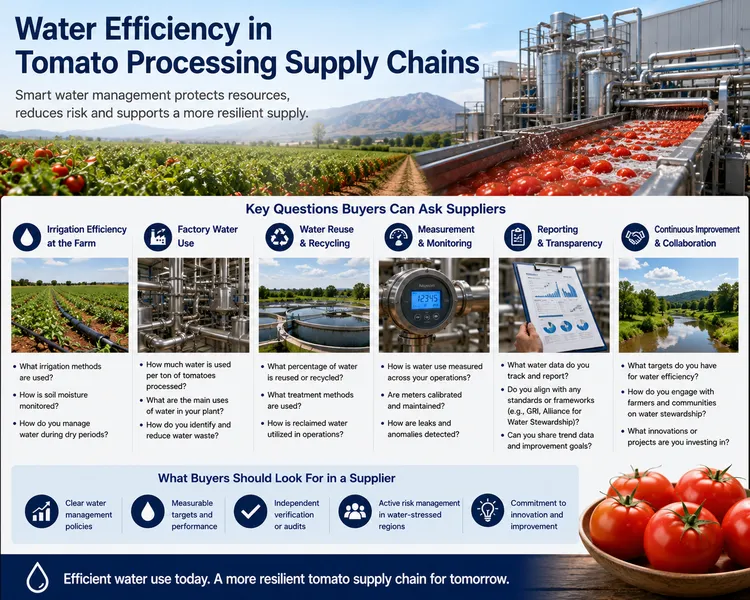
Tomato processing is closely linked to agricultural growing conditions, so water management can affect both crop resilience and long-term supply planning. Buyers assessing tomato ingredients may therefore want to understand not only factory water use, but also how suppliers work with growers and processing sites to measure, manage and improve water efficiency.
Water-use information is most useful when it is connected to a defined measurement boundary. Irrigation water used in agriculture, water received at the processing plant, water reused within factory operations and wastewater leaving the facility describe different parts of the supply chain and should not automatically be treated as equivalent metrics.
Look beyond a single water number
A headline water-use figure can be useful, but it rarely tells the entire story. Buyers should ask what the number measures, which facilities or farms are included, which production period it represents and what production unit is used as the denominator.
Comparing suppliers is more meaningful when reporting boundaries are reasonably consistent. For example, a factory-only water metric should not be directly compared with another supplier's figure that also includes agricultural irrigation unless the difference is clearly understood.
Irrigation and agricultural water use
Water requirements at farm level can vary according to climate, rainfall, soil conditions, crop timing, irrigation infrastructure and growing region. Buyers interested in agricultural water management can ask suppliers how irrigation practices are monitored and whether growers use methods intended to improve application efficiency.
Useful discussion points can include irrigation scheduling, field monitoring, maintenance of irrigation systems and the extent to which growers or agricultural teams track water use. The objective is not simply to identify one preferred farming method, but to understand whether water decisions are measured and managed in a structured way.
Factory water use
Tomato processing plants can use water at several stages, including raw-material handling, washing, process operations, cleaning and utility systems. The relative importance of each use can differ by plant design, product type and processing configuration.
Buyers can ask whether facilities meter total water intake and whether important production areas are monitored separately. More detailed measurement can help processors identify unusual consumption, evaluate improvement projects and distinguish production growth from genuine efficiency gains.
Water reuse and recirculation
Some processing operations can incorporate water reuse or recirculation where technically and hygienically appropriate. Buyers should ask what water streams are reused, how their suitability is controlled and whether reuse is incorporated into the facility's overall efficiency program.
A higher reuse rate should still be considered within the context of food safety, product quality and local requirements. Water-efficiency programs should support safe processing rather than encourage reductions that compromise necessary washing, sanitation or process controls.
Measurement and intensity metrics
Water efficiency is often easier to follow when absolute consumption is reviewed together with an intensity metric. Depending on the supplier, this may be expressed relative to raw tomato intake, finished-product output or another production measure.
Before comparing figures, confirm the unit, reporting period and production basis. Concentrated tomato ingredients can also differ substantially in solids, so commercial comparisons should keep product concentration and usable output in view rather than relying only on tonnes of finished material.
Regional context
Tomato-growing regions differ in rainfall, irrigation dependence and seasonal water conditions. The same water-use figure can therefore have a different operational context in two sourcing regions.
For strategic sourcing, buyers may wish to understand the origin of the crop, the reliability of water supply and how the supplier incorporates changing seasonal conditions into agricultural and production planning. This can complement conventional evaluations of price, specification, capacity and logistics.
Improvement programs and targets
A useful supplier conversation goes beyond current performance and asks how improvement is managed. Processors may track projects related to metering, leak reduction, cleaning optimization, recirculation, equipment upgrades or operational practices.
When a supplier reports an efficiency target, ask for the baseline year, measurement boundary and progress method. Consistent reporting makes it easier to determine whether improvement reflects actual operational change rather than a change in production mix or reporting methodology.
Ingredient selection and sourcing
Separate must-have technical requirements from negotiable preferences. This creates alternate-source flexibility without compromising critical finished-product attributes. For this topic, a logical starting point is processed tomato ingredients, evaluated together with supplier origin, production site, water-management information and commercial continuity.
Water efficiency should normally be considered alongside product quality, food safety, crop availability, logistics, cost and technical performance. A sourcing decision is strongest when sustainability information is incorporated without losing sight of the ingredient's ability to perform consistently in the finished product.
Practical supplier-review method
Compare suppliers using clearly defined technical and commercial criteria while requesting enough water-management information to understand measurement scope, current practices and improvement direction.
- Define the tomato ingredient, crop origin, production site and supply volume being evaluated.
- Ask which water-use data is measured at farm level, factory level or both.
- Confirm the reporting units, time period and measurement boundaries before comparing figures.
- Review irrigation-management practices relevant to the supplier's growing region.
- Ask how factory water intake, major uses, reuse and wastewater flows are monitored.
- Identify current efficiency projects, targets and the baseline used to measure improvement.
- Compare water information together with ingredient specification, usable solids, packaging, lead time, cost and continuity.
- Document the supplier, production site, reporting period and methodology so future data can be compared consistently.
Commercial considerations
Sustainability criteria are most useful when incorporated into a broader sourcing model. Compare offers on landed usable solids, approved quality, packaging efficiency, lead time, documentation, continuity and relevant environmental information—not unit price alone.
When two products have different concentrations, normalize the commercial comparison where possible. A more concentrated tomato ingredient can change freight, packaging and handling requirements, so water-related data should be interpreted alongside the complete supply-chain configuration.
Questions to ask the supplier
- Which growing region and processing site supply this product?
- How is agricultural or irrigation water use monitored?
- What irrigation practices are commonly used within the supply program?
- Does the processing facility measure total water intake?
- Are major factory water uses separately metered or monitored?
- Which process-water streams are reused or recirculated?
- How is reused water managed for appropriate quality and process requirements?
- How is water-use intensity calculated?
- What production unit is used as the denominator for reported water figures?
- What reporting period and facilities are included in the data?
- Are water-efficiency targets or improvement projects currently in place?
- What baseline is used to measure progress?
- How are seasonal or regional water constraints incorporated into supply planning?
- What documentation is available to support reported water-management information?