
Product overview
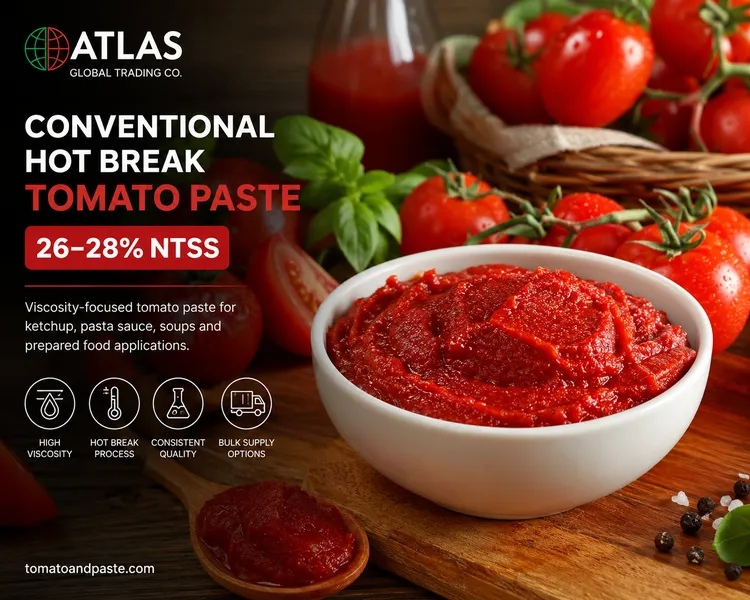
Conventional hot break tomato paste around 26–28% NTSS is designed for industrial formulations where tomato solids and viscosity must work together to provide body, texture and tomato character. The concentration can be particularly useful in ketchup, sauces, soups and prepared foods where the tomato base contributes materially to finished-product consistency.
Atlas Global Trading Co. sources tomato ingredients through a multi-origin network of farms, processors and supply partners. We match available supply programs to the customer’s target NTSS, consistency, color, finish, commercial pack format, annual volume and destination requirements.
26–28% NTSS specification
NTSS refers to natural tomato soluble solids and is used to define the concentration of tomato-derived soluble material in the ingredient. A 26–28% NTSS program offers controlled tomato solids with somewhat lower concentration than higher-NTSS paste formats, which can simplify reconstitution in certain formulations.
NTSS should be evaluated together with consistency, color, finish and process characteristics. Products within the same solids range may still perform differently during pumping, blending, cooking and filling.
Hot break viscosity
The hot break process is commonly selected where stronger viscosity and tomato body are desired. It can help support texture in applications where the tomato paste itself is expected to make a meaningful contribution to finished-product consistency.
Exact viscosity depends on the processor, crop characteristics and agreed specification. Buyers should therefore define the target consistency or Bostwick range instead of relying solely on the hot break designation.
Specification focus
Common control points include NTSS, Bostwick or other consistency measurements, color, pH, acidity, finish and commercial sterility. Flavor and additional microbiological parameters may also be defined according to the selected supply program.
For viscosity-sensitive formulations, the complete specification should be reviewed before approval. Solids concentration alone does not fully describe the paste’s flow behavior or contribution to finished-product texture.
Typical applications
- Ketchup and tomato condiments
- Pizza and cooking sauces
- Pasta and tomato-based sauces
- Soups and concentrated soup bases
- Ready meals and prepared foods
- Foodservice and industrial tomato systems
Formulation considerations
The 26–28% NTSS concentration can be diluted to the desired finished solids or incorporated directly into recipes that contain additional liquid ingredients. It may also be combined with puree, diced tomatoes, seasonings, sweeteners, acids and other formulation components.
Because hot break paste already contributes viscosity, manufacturers should account for its natural body when determining the required level of starches, gums or other texture-building ingredients.
Industrial handling
Product temperature, pump design, line diameter, extraction equipment and dilution sequence can all affect the handling of hot break tomato paste. Manufacturers should verify that their receiving and blending systems are suitable for the selected consistency.
When moving between processors or origins, production-representative testing can help confirm pumpability, dilution behavior and final viscosity before large-scale use.
Bulk packaging and storage
Industrial hot break tomato paste is commonly supplied in aseptic bags in drums or larger bulk bins, subject to processor and supply program. Exact net weight, liner configuration, palletization and container loading vary by origin.
Storage conditions and shelf life are product-specific and should be confirmed on the current technical specification and lot documentation.
Conventional supply programs
Conventional programs can be optimized around technical performance, economics, origin, freight efficiency and continuity of supply. Multi-origin sourcing can provide additional flexibility when customers are balancing specification requirements, crop availability and delivery timing.
Documentation and commercial planning
Depending on the selected program, documentation may include the current technical specification, certificate of analysis and relevant lot or shipment records. Exact documentation availability is confirmed with each commercial offer.
A complete inquiry should include target NTSS, consistency or Bostwick requirement, color and finish expectations, pH or acidity limits where relevant, pack format, annual or shipment volume, documentation needs and delivery destination.