
Product overview
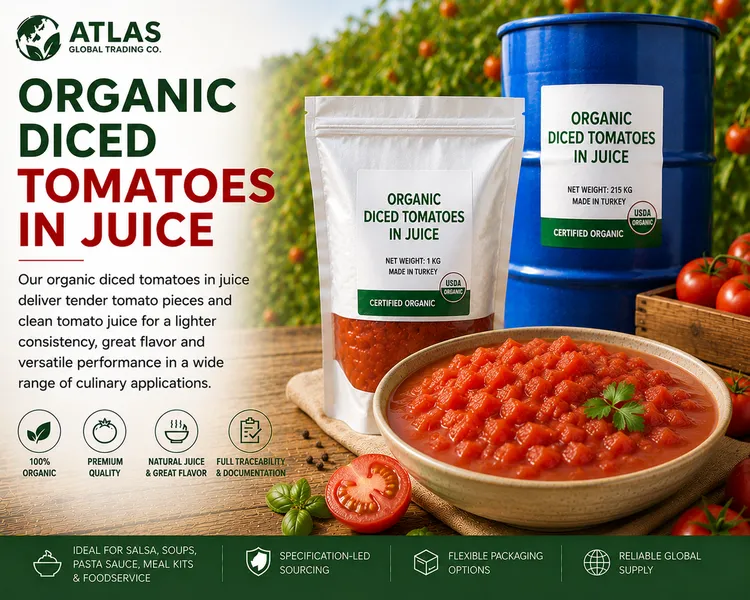
Organic diced tomatoes in juice combine certified-organic tomato pieces with a tomato juice packing medium. The format provides recognizable tomato texture while contributing less background body than diced tomatoes packed in puree, making it useful where formulators want more control over the final sauce or liquid phase.
The product can be incorporated into salsa, soups, pasta sauces, meal kits, ready meals and foodservice recipes where visible tomato pieces are important. Depending on the application, buyers may prioritize firmness and piece retention or prefer a softer dice that integrates more readily during cooking.
Atlas Global Trading Co. sources tomato ingredients through a multi-origin network of farms, processors and supply partners. We match the ingredient to the customer’s required organic certification, cut size, firmness, juice medium, pack format, technical documentation, destination and supply program.
Specification focus
Dice size is a primary purchasing parameter because it influences visual appearance, mouthfeel, portioning and distribution in the finished product. Smaller dice can disperse more evenly through sauces and soups, while larger pieces can provide a more pronounced chunky character in salsa and prepared meals.
Firmness or piece integrity should be specified according to the customer’s process. A firmer dice may retain its shape better through pumping, mixing and thermal processing, while a softer product may be more appropriate where the tomato is intended to blend into the finished formulation.
Peel tolerance, seed content, color, pH, acidity, defect limits and microbiological criteria may also be included in the approved specification. These requirements should be aligned with the finished application and customer quality program.
Juice packing medium
The juice surrounding the diced tomatoes contributes tomato flavor, liquid and soluble solids while maintaining a lighter background than a puree-based packing medium. This can provide flexibility for manufacturers that want to build final body using paste, starches, hydrocolloids or other recipe components.
Buyers should confirm the characteristics of the juice medium and how it is represented in the technical specification. Incoming liquid level, drained solids and total tomato contribution can influence formulation calculations and finished yield.
Drained solids and piece distribution
For applications where the tomato pieces are a major visual component, buyers may evaluate the relationship between total pack weight and drained tomato solids. This helps determine how much usable diced tomato is delivered relative to the surrounding juice.
The relevant measurement approach and contractual acceptance criteria should be confirmed with the selected processor rather than assumed across different supply programs.
Piece integrity through processing
Diced tomatoes can soften and fragment during mixing, pumping and heating. Where recognizable pieces are important, manufacturers should review pump design, mixer intensity, processing time and the point at which the diced tomatoes are added.
Adding the product later in a process can sometimes help preserve more visible pieces, depending on the formulation and equipment. Pilot or plant trials are useful when qualifying a new processor, cut size or firmness profile.
Juice versus puree packing
Diced tomatoes in juice generally provide a lighter surrounding tomato phase than diced tomatoes in puree. This can be advantageous where the customer wants visible tomato pieces without adding as much background body from the packing medium.
Diced tomatoes in puree may be preferred when additional tomato solids and sauce body are desirable. The correct format depends on recipe water balance, finished texture, target solids and how much additional paste, puree or thickener is used in the formulation.
Typical applications
- Organic salsa and chunky dips
- Soups, stews and culinary bases
- Meal kits and ready-to-cook products
- Pasta and tomato-based sauces
- Prepared meals and chilled foods
- Foodservice and institutional applications
Packaging and handling
Organic diced tomatoes in juice may be available in aseptic, canned, pouch, foodservice or other industrial formats depending on processor capability and the selected program.
Buyers should confirm net weight, drained weight where relevant, juice or packing-medium characteristics, container or liner configuration, palletization, storage conditions and shelf life. Receiving teams should verify package integrity and lot identification before production use.
Organic program controls
Organic certification is a core part of the product specification. We confirm certification scope and supporting records for the selected processor, origin and supply lot, including relevant chain-of-custody documentation where applicable.
Buyers should provide the destination market and any customer-specific organic requirements during inquiry. The diced tomato pieces, juice packing medium and any other formulation inputs should align with the intended organic program and final ingredient declaration.
Final organic claims should remain aligned with the approved product, processor certification, supply documentation and destination-market requirements.