
Product overview
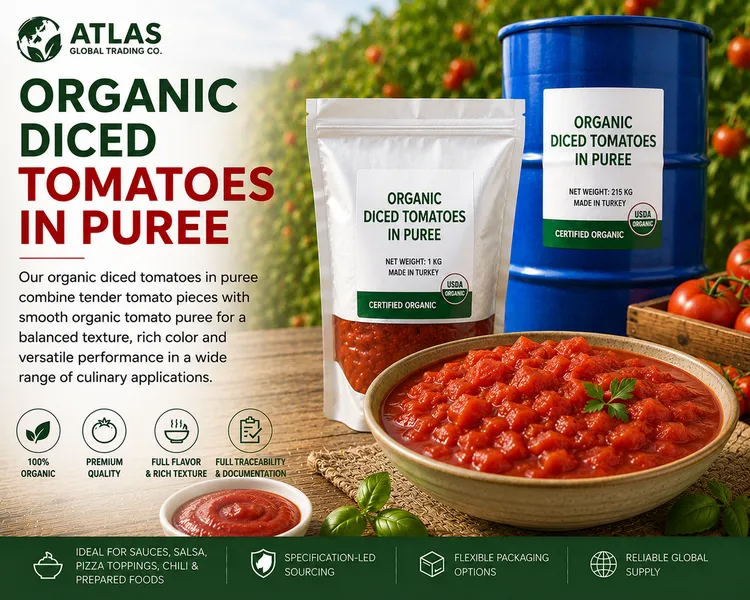
Organic diced tomatoes in puree combine cut tomato pieces with a tomato puree packing medium under a certified-organic supply program. The diced portion contributes visible tomato texture, while the surrounding puree adds tomato solids, color and body to the overall formulation.
This format can be useful for manufacturers that want both particulate tomato identity and a more substantial sauce base than diced tomatoes packed in a lighter juice medium. It is commonly considered for pasta sauces, salsa, pizza products, chili, soups and ready meals.
Atlas Global Trading Co. sources tomato ingredients through a multi-origin network of farms, processors and supply partners. We match the ingredient to the customer’s required organic certification, dice size, firmness, puree characteristics, commercial pack format, technical documentation, destination and supply program.
Specification focus
Dice size should be defined according to the intended application. Smaller dice can distribute more evenly through sauces and fillings, while larger pieces can provide a more pronounced visual and textural identity in salsa, chili and prepared meals.
Piece firmness is another important criterion. Buyers should consider how well the dice need to retain their shape through pumping, mixing, cooking, filling and any subsequent thermal processing.
Puree soluble solids, consistency and ratio to tomato pieces can affect the body of the incoming ingredient and the finished formulation. Customers using the product as a sauce base should therefore review the puree characteristics alongside dice size and drained-solid behavior.
Peel tolerance, seed content, color, pH, acidity, defect limits and microbiological criteria may also be included in the approved specification. The appropriate limits depend on the finished product, process and customer quality requirements.
Dice size and piece integrity
The physical condition of the dice can influence finished-product appearance and mouthfeel. Products with stronger piece integrity may be preferred where recognizable tomato cubes should remain visible after processing, while softer dice can integrate more readily into cooked sauce systems.
Manufacturers using pumps or high-shear mixers should evaluate how the proposed product behaves through their equipment. Excessive mechanical treatment can reduce dice definition and increase the proportion of smaller tomato fragments.
Representative samples or production trials can help confirm that the selected cut and firmness remain suitable after the customer's complete process.
Puree background and formulation body
Packing diced tomatoes in puree creates a different formulation effect from packing them in juice. The puree contributes additional tomato solids and can provide a fuller base around the visible pieces.
In pasta sauce, chili and prepared-food systems, this may reduce the need for separate additions of puree or other tomato bases, depending on the finished recipe. Manufacturers should still balance the incoming puree solids against any tomato paste, water or other liquid components in the formulation.
Final sauce consistency will depend on the total recipe, including other vegetables, starches, hydrocolloids, fats, salts, acids and thermal processing conditions.
Peel and defect tolerances
Visible diced tomato applications may require defined tolerances for peel, cores, damaged pieces and other product-specific defects. These limits should be agreed commercially and reviewed in the current technical specification.
Where a finished product has a premium or highly visible appearance, buyers may want to evaluate color uniformity and representative samples in addition to numerical specification limits.
Processing behavior
Diced tomatoes in puree can be incorporated directly into many wet formulations, but the order and intensity of mixing can influence piece retention. Adding the product later in the process may help preserve larger dice where a chunky finished texture is desired.
Thermal processing can soften both the tomato pieces and puree background. Manufacturers should therefore evaluate final texture, drained solids and overall consistency after the full commercial process rather than only on the incoming product.
Typical applications
- Organic pasta and culinary sauces
- Salsa and chunky tomato dips
- Pizza sauces and tomato toppings
- Chili and bean-based prepared foods
- Soups, stews and meal components
- Ready meals and private-label tomato products
Packaging and handling
Organic diced tomatoes in puree may be available in aseptic, canned, pouch, foodservice or other industrial formats depending on processor capability. Pack selection should reflect plant equipment, annual volume, storage conditions and the intended finished product.
Buyers should confirm net weight, drained weight where relevant, puree or packing-medium characteristics, liner or container configuration, palletization, shelf life and storage requirements. Receiving teams should also verify package integrity and lot identification before production use.
Organic program controls
Organic certification is a core part of the product specification. We confirm certification scope and supporting records for the selected processor, origin and supply lot, including relevant chain-of-custody documentation where applicable.
Buyers should provide the destination market and any customer-specific organic requirements during inquiry. The tomato dice, puree medium and any other formulation components should all align with the intended organic program and final ingredient declaration.
Final organic claims should remain aligned with the approved product, processor certification, supply documentation and destination-market requirements.