
Product overview
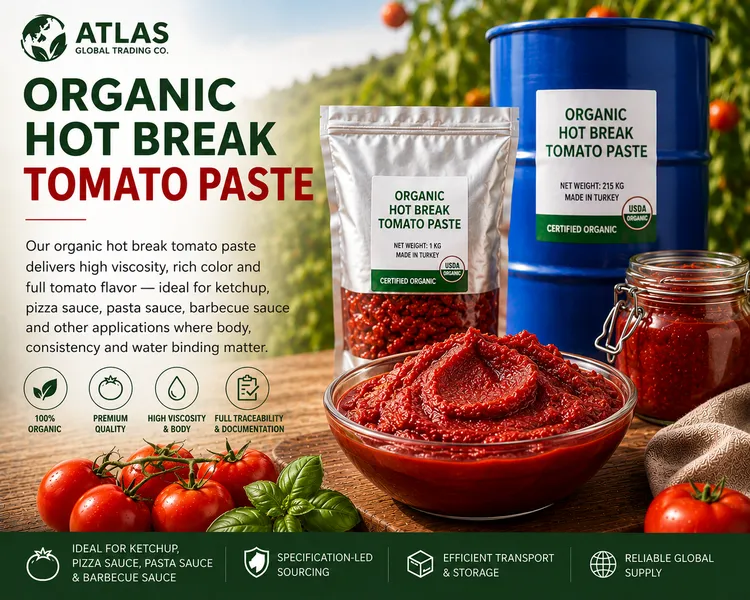
Organic hot break tomato paste is a concentrated tomato ingredient produced from certified-organic tomatoes using a hot-break processing approach. The process is generally selected to retain more natural tomato viscosity and body, making the paste useful in formulations where thickness, cling and water management are important.
Typical applications include ketchup, pizza sauce, pasta sauce, barbecue sauce, soups and other prepared foods that rely on tomato paste not only for flavor and color but also for structural contribution to the finished product.
Atlas Global Trading Co. sources tomato ingredients through a multi-origin network of farms, processors and supply partners. We match the ingredient to the customer’s target solids, consistency, organic certification requirements, commercial pack format, technical documentation, destination and supply program.
Hot break functionality
Hot-break processing is commonly associated with higher viscosity because the tomato material is heated early in processing in a way that helps preserve more of the natural pectin-related structure responsible for body and consistency.
In practical formulation terms, this can make hot break paste attractive where the finished product needs thickness, spoonability, sauce cling or resistance to water separation. Actual performance still depends on the processor, concentration, consistency target and complete recipe.
Manufacturers should therefore qualify the paste using the approved technical specification and application trials rather than relying on the hot-break designation alone.
Specification focus
Common industrial programs may include approximately 26–28, 28–30 and 29–31° Brix or related soluble-solids ranges, subject to the selected processor’s specification. The exact contractual concentration should be confirmed for each offer and lot.
Consistency or viscosity is particularly important for hot break paste. Buyers should specify the required test method and target rather than using Brix as the only performance indicator, because two pastes with similar soluble solids can behave differently in the finished product.
Color, pH, acidity, finish and microbiological parameters may also be included in the approved specification. These characteristics should be aligned with the intended formulation, thermal process and customer- specific quality requirements.
Consistency and water binding
In sauces and ketchup systems, hot break paste can contribute to body and help manage the water phase of the formulation. This can support a thicker finished texture and may reduce visible separation depending on the complete recipe and processing method.
Final consistency is influenced by more than the incoming paste. Dilution, sugar or sweetener level, salt, acids, hydrocolloids, mechanical shear, heating profile and total solids can all change the texture observed in production.
For this reason, manufacturers qualifying a new source should evaluate the paste in the complete formulation under realistic plant conditions.
Hot break versus cold break
Hot break paste is generally selected when viscosity and body are major priorities. Cold break paste may be considered where a different balance of flavor, color and lower viscosity is more appropriate.
Neither process type is universally better. The correct choice depends on the finished application, target consistency, desired sensory profile and processing system.
Reconstitution and processing
Organic hot break tomato paste is normally diluted or blended with other recipe ingredients during manufacturing. Accurate water addition is important because the dilution ratio affects finished solids, viscosity, color, flavor and production yield.
Mixing intensity should also be considered. Excessive shear may change the apparent viscosity of some tomato systems, while insufficient mixing can leave localized areas of concentrated paste.
Plant trials can help confirm pumpability, dilution behavior and final consistency when switching processor, concentration or origin.
Typical applications
- Ketchup and tomato condiments
- Pizza sauce and pizza topping systems
- Pasta and culinary sauces
- Barbecue sauce and thick dipping sauces
- Soups and concentrated soup bases
- Prepared foods requiring tomato body and viscosity
Packaging and plant handling
Organic hot break tomato paste may be supplied in aseptic drums, larger bulk containers or other industrial formats depending on processor capability. Selected foodservice or retail formats may also be possible under specific programs.
Buyers should confirm net weight, liner and container configuration, palletization, shelf life, storage conditions and unloading method. Higher-viscosity products should also be reviewed for compatibility with the receiving plant’s pumps, transfer lines and mixing equipment.
Organic program controls
Organic certification is a core part of the product specification. We confirm certification scope and supporting documentation for the selected processor, origin and supply lot, including relevant chain-of- custody records where applicable.
Buyers should provide the destination market and any customer-specific organic requirements during inquiry because accepted certification and labeling pathways can vary by market.
Final organic claims should remain aligned with the approved ingredient, processor certification, supply documentation and destination-market requirements.