
Product overview
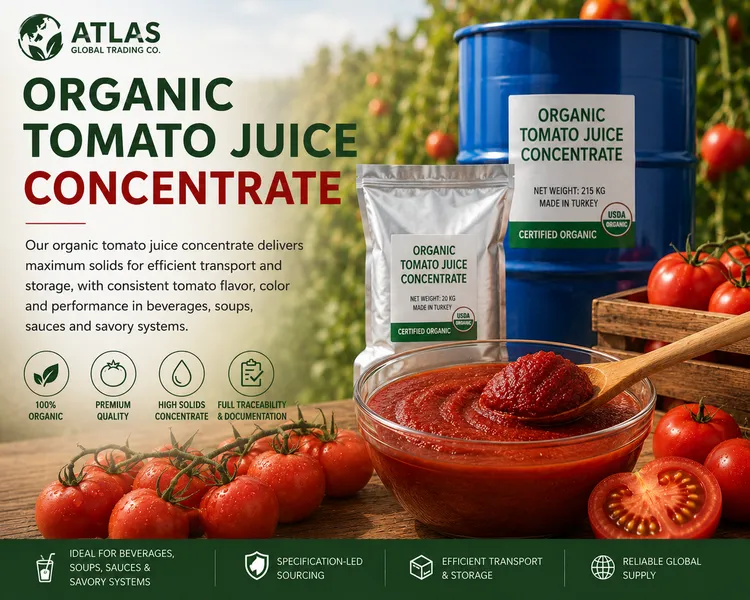
Organic tomato juice concentrate is a certified-organic liquid tomato ingredient from which part of the naturally occurring water has been removed. This provides a more concentrated tomato-solids source than standard tomato juice while remaining positioned for beverage and culinary systems where controlled reconstitution is important.
The concentrate can be diluted during processing to a target solids level or incorporated directly into formulations that also contain water, broth, vegetable juice or other liquid ingredients. This flexibility can support beverage blends, soups, sauces, savory bases and other industrial formulations.
Atlas Global Trading Co. sources tomato ingredients through a multi-origin network of farms, processors and supply partners. We match the ingredient to the customer’s required concentration, flavor profile, organic certification, commercial pack format, technical documentation, destination and supply program.
Specification focus
Concentration or soluble solids should be confirmed for the selected supply program. The incoming solids level influences dilution ratio, delivered tomato solids, recipe yield and the amount of water that must be restored during manufacturing.
Clarification and pulp level may also be relevant. Some applications favor a smoother, more clarified liquid, while others can accommodate or prefer more suspended tomato solids. Buyers should define the desired appearance and texture according to the finished product.
Color, flavor, pH, acidity and microbiological limits can form part of the approved specification. These characteristics should be reviewed together because concentration and subsequent reconstitution can affect the final sensory balance.
Organic certification and ingredient composition should be confirmed before approval. Where salt or other permitted ingredients are relevant to a particular program, their presence and declaration should be reviewed on the current technical specification.
Reconstitution and yield control
One of the main uses of tomato juice concentrate is controlled reconstitution. Manufacturers can add water to restore a target juice strength or use the concentrate as part of a broader liquid formulation.
Reconstitution should be calculated from the actual approved solids value rather than a generic product assumption. Precise water addition can help maintain consistent finished concentration, flavor intensity, color and production yield.
Mixing sequence, agitation and temperature may influence how quickly the concentrate becomes uniform. Pilot or plant trials are useful when a new source is introduced or when the product is replacing a different concentration.
Transport and storage efficiency
Concentrating tomato juice reduces the amount of water transported relative to a ready-strength juice. This can improve freight and storage efficiency where the receiving plant has suitable reconstitution capability.
The commercial benefit should be evaluated on the complete delivered system, including concentration, freight, storage, packaging, unloading, reconstitution and usable tomato solids rather than price per container alone.
Flavor and application behavior
Concentrated tomato juice can contribute tomato flavor and color without necessarily providing the same viscosity profile as tomato paste. This can make it useful in systems where liquid tomato character is required but very high paste-like body is not.
In vegetable beverages and broths, manufacturers may prioritize clean flavor, color and a controlled level of suspended solids. In soups and sauces, the concentrate may be combined with starches, gums, vegetables, paste or other ingredients to build the final body.
Typical applications
- Organic vegetable and savory beverages
- Soups and concentrated soup bases
- Broths and culinary liquid systems
- Sauces and dipping formulations
- Savory blends and prepared foods
- Industrial reconstitution programs
Packaging and handling
Organic tomato juice concentrate may be supplied in aseptic drums, larger bulk containers or other industrial packaging depending on processor capability. Selected foodservice configurations may also be possible under specific programs.
Receiving teams should confirm net weight, container and liner configuration, lot coding, storage instructions and shelf-life documentation. Transfer and unloading equipment should be appropriate for the selected concentration and package type.
Organic program controls
Organic certification is a core part of the product specification. We confirm certification scope and supporting records for the selected processor, origin and supply lot, including relevant chain-of-custody documentation where applicable.
Buyers should provide the destination market and any customer-specific organic requirements because accepted certification and labeling pathways can differ by market and commercial program.
Final organic claims should remain aligned with the approved ingredient, processor certification, supply documentation and destination-market requirements.