
Product overview
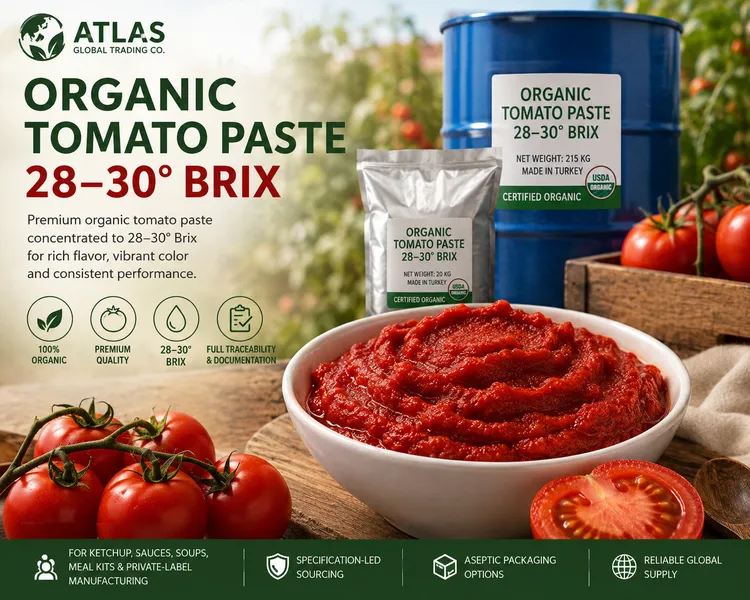
Organic tomato paste at 28–30° Brix is a double-concentrated tomato ingredient produced from certified-organic tomatoes for industrial food manufacturing. It provides significantly more tomato solids than puree or juice while remaining less concentrated than 36–38° Brix paste.
This balance makes the format useful across ketchup, sauces, soups, meal-kit components, prepared foods and private-label manufacturing. Manufacturers can reconstitute the paste with water and combine it with other recipe ingredients to reach their required finished solids, viscosity, flavor and color.
Atlas Global Trading Co. sources tomato ingredients through a multi-origin network of farms, processors and supply partners. We match the ingredient to the customer’s target Brix, process style, consistency, organic certification requirements, commercial pack format, technical documentation, destination and supply program.
Specification focus
Soluble solids are one of the primary purchasing parameters. Buyers requesting a 28–30° Brix program should confirm the contractual solids range, test method and acceptable lot variation with the selected processor rather than relying on the general product category alone.
Process type can influence finished-product behavior. Hot-break programs are commonly considered where viscosity and body are important, while cold-break characteristics may be relevant where a different balance of flavor, color and consistency is required. Exact process style should always be confirmed on the current specification.
Consistency or viscosity should be specified independently from Brix because products at similar soluble-solids levels can still behave differently during pumping, dilution, cooking and filling. Buyers should identify the consistency method and target range most relevant to their application.
Color, pH, acidity, finish and microbiological parameters may also form part of the approved specification. These requirements should be aligned with the finished recipe, thermal process, storage system and customer- specific quality standards.
Formulation yield and reconstitution
Because 28–30° Brix paste is concentrated, manufacturers can control the final tomato-solids level by adjusting water addition during reconstitution. This can support consistent recipe yield when incoming product concentration is kept within the approved specification.
Reconstitution calculations should use the actual lot or contractual solids value where precision matters. In large batches, relatively small differences in incoming concentration can affect finished Brix, viscosity and total batch yield.
When changing from another concentration, such as 30–32° or 36–38° Brix, manufacturers should recalculate both paste and water additions rather than making a direct weight-for-weight substitution.
Handling and processing
A 28–30° Brix paste can offer a practical compromise between concentration and plant handling. Compared with more highly concentrated paste, it may require less effort to pump or disperse, although actual handling depends on viscosity, temperature, process style and equipment.
Mixing sequence, water temperature, shear and agitation time can affect how quickly the paste becomes uniform after dilution. Plants qualifying a new source should verify pumpability, dispersion and final texture under realistic processing conditions.
Typical applications
- Ketchup and tomato condiments
- Pizza, pasta and culinary sauces
- Soups and soup bases
- Meal kits and prepared foods
- Private-label tomato products
- Industrial tomato blending and further processing
Packaging and logistics
Organic 28–30° Brix tomato paste may be supplied in aseptic industrial formats such as drums or larger bulk containers, depending on processor capability. Selected foodservice or retail formats may also be available under specific commercial programs.
Buyers should confirm net weight, liner and container configuration, palletization, storage instructions, shelf life and unloading method. Shipment size, destination and annual volume can influence the most practical origin and packaging pathway.
Organic program controls
Organic certification is a core part of the supply specification. We confirm certification scope and supporting documentation for the selected processor, origin and supply lot, including relevant chain-of- custody records where applicable.
Buyers should state the destination market and any customer-specific organic requirements during inquiry because accepted certification and labeling pathways can differ between markets and commercial programs.
Final organic claims should remain aligned with the approved ingredient, processor certification, supply documentation and destination-market requirements.