
Product overview
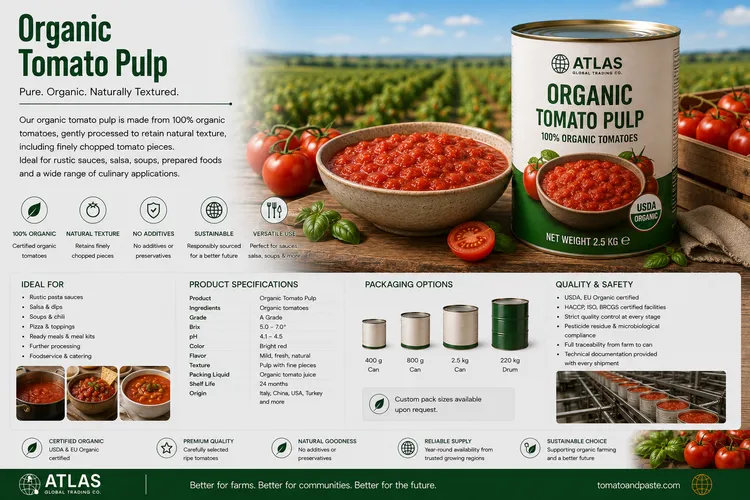
Organic tomato pulp is a certified-organic wet tomato ingredient designed to retain more natural tomato texture and suspended solids than a finely finished puree. Depending on the selected processor and production method, the product may contain defined levels of pulp, seeds, fine skin particles or other naturally occurring tomato solids.
This format can be useful in rustic pasta sauces, salsa, soups, prepared meals and foodservice systems where manufacturers want a tomato base with visible texture rather than a completely smooth finish.
Atlas Global Trading Co. sources tomato ingredients through a multi-origin network of farms, processors and supply partners. We match the ingredient to the customer’s finished-product performance, organic certification requirements, commercial pack format, technical documentation, destination and supply program.
Specification focus
Particle size and texture are central purchasing parameters. Buyers should define whether they want a relatively fine pulp for smooth processing or a coarser tomato structure that remains more visible in the finished sauce, salsa or prepared food.
Seed and skin tolerance should also be specified. Some formulations can accommodate naturally occurring fine seed or skin material, while other products require tighter defect or finish tolerances for appearance and mouthfeel.
Soluble solids or Brix may be relevant depending on the program because concentration influences tomato intensity, yield and the amount of additional water required in the recipe. Buyers may also evaluate color, pH, acidity, flavor and microbiological limits as part of the approved specification.
Packing medium and overall consistency can influence pumping, mixing, filling and finished-product texture. Where the pulp is supplied with a surrounding tomato liquid, both the solid fraction and liquid phase should be considered when evaluating application performance.
Pulp versus puree
Tomato pulp and tomato puree can overlap in solids content but generally differ in physical finish and texture. Puree is typically selected when the formulation needs a smoother and more homogeneous tomato base, while pulp is useful when visible tomato solids or a more rustic texture are desirable.
The best choice depends on the finished product, processing equipment and expected consumer texture. Manufacturers may also blend pulp with puree or paste to balance natural texture with solids concentration and viscosity.
Processing and texture retention
Mechanical shear can reduce the visible texture of tomato pulp. High-shear mixing, pumping or extended cooking may break larger pulp particles into a smoother final system, while gentler processing can preserve more of the original tomato structure.
Manufacturers should therefore evaluate the ingredient under realistic mixing, heating and filling conditions. Pilot trials can help confirm whether the selected particle profile remains suitable after the full production process.
Typical applications
- Rustic pasta and tomato sauces
- Salsa and textured dipping sauces
- Soups and culinary bases
- Prepared meals and ready foods
- Foodservice and institutional kitchens
- Organic private-label formulations
Packaging and handling
Industrial organic tomato pulp may be supplied in aseptic drums, bins or other bulk formats depending on processor capability. Selected foodservice or retail configurations may also be available where the commercial program supports smaller packs.
Receiving teams should verify package integrity, lot coding, storage instructions and shelf-life documentation. The exact storage and handling requirements should follow the approved product specification and supplying processor’s documentation.
Organic program controls
Organic certification is a core part of the supply program. We confirm certification scope and supporting documentation for the selected processor, origin and supply lot, including relevant chain-of-custody records where applicable.
Buyers should provide the destination market and any customer-specific certification requirements because accepted organic certification pathways and labeling expectations can differ by market and commercial program.
Final organic claims should remain aligned with the approved product, processing inputs, certification scope, packing configuration and destination-market requirements.