
Product overview
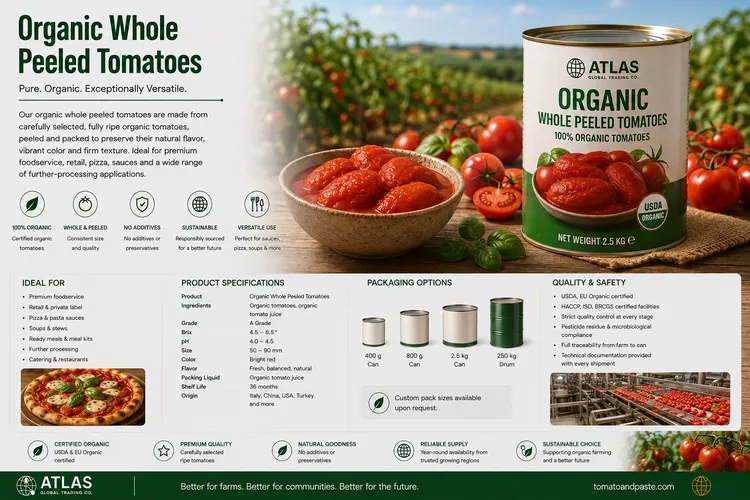
Organic whole peeled tomatoes are certified-organic tomatoes processed to remove the peel while retaining the fruit in a whole format. They are commonly packed in tomato juice, puree or another approved tomato-based medium depending on the processor and intended commercial program.
The whole format is useful when the buyer wants flexibility during downstream preparation. Foodservice operators may crush or break the tomatoes by hand, while industrial processors may use them as a starting material for premium sauces, pizza products, prepared foods or other tomato applications where visible fruit character is desirable.
Atlas Global Trading Co. sources tomato ingredients through a multi-origin network of farms, processors and supply partners. We match the ingredient to the customer’s organic requirements, finished-product performance, commercial pack format, documentation needs, destination and supply program.
Specification focus
Packing medium is an important buying parameter because it influences the overall tomato solids, flavor and usable yield of the pack. Buyers should confirm whether the product is packed in juice, puree or another approved tomato medium and review the specification for both the fruit and surrounding liquid.
Net weight and drained weight should be considered separately. For applications that primarily use the whole tomato pieces, drained weight can provide a more useful indication of usable fruit yield than total container weight alone.
Tomato size, variety and shape may also matter, particularly in premium culinary or retail programs. Where consistent whole-fruit appearance is important, buyers may define size ranges, acceptable broken-fruit levels, peel defects and other visual tolerances.
Color, firmness, flavor and piece integrity can affect downstream performance. Tomatoes intended for crushing into sauce may prioritize flavor and processing behavior, while retail or foodservice programs may place greater emphasis on whole-fruit appearance and consistency.
Peel and defect control
Whole peeled tomato specifications commonly address residual peel, stem-core material, damaged fruit, broken pieces and other visible defects. Acceptable limits should be agreed in the commercial specification rather than assumed from the product name alone.
For premium applications, sample evaluation can help establish whether the selected product meets expectations for appearance, firmness and handling before a larger commercial program is approved.
Processing and application behavior
The intact fruit format gives manufacturers control over the final texture. Whole tomatoes can be gently crushed for a rustic sauce, chopped for visible pieces or processed more aggressively for a smoother base.
Thermal processing, mixing intensity and cook time can influence how quickly the fruit breaks down. Buyers using the product in pizza sauce, premium pasta sauce or prepared foods should validate the tomato under realistic process conditions to confirm the desired final texture.
Typical applications
- Premium foodservice and culinary use
- Pizza and pizza-sauce preparation
- Premium pasta and tomato sauces
- Organic private-label retail programs
- Further cutting, crushing or blending
- Prepared foods and institutional kitchens
Packaging and handling
Organic whole peeled tomatoes may be supplied in retail or foodservice cans and other shelf-stable formats subject to processor capability. Pack selection should consider serving size, usage rate, storage, handling and the customer's downstream process.
Receiving teams should review container integrity, lot coding, net and drained weight requirements, storage instructions and shelf-life documentation. Exact case count and pallet configuration are confirmed with the selected supply program.
Organic program controls
Organic status is a central part of the product specification. We confirm certification scope and supporting documentation for the selected processor, product and supply lot, including relevant chain-of-custody records where applicable.
Buyers should state the destination market and any customer-specific organic certification expectations because accepted certification pathways and label requirements can differ by market and program.
Final organic claims should remain aligned with the approved product, packing medium, processing inputs, certification scope and destination- market requirements.