
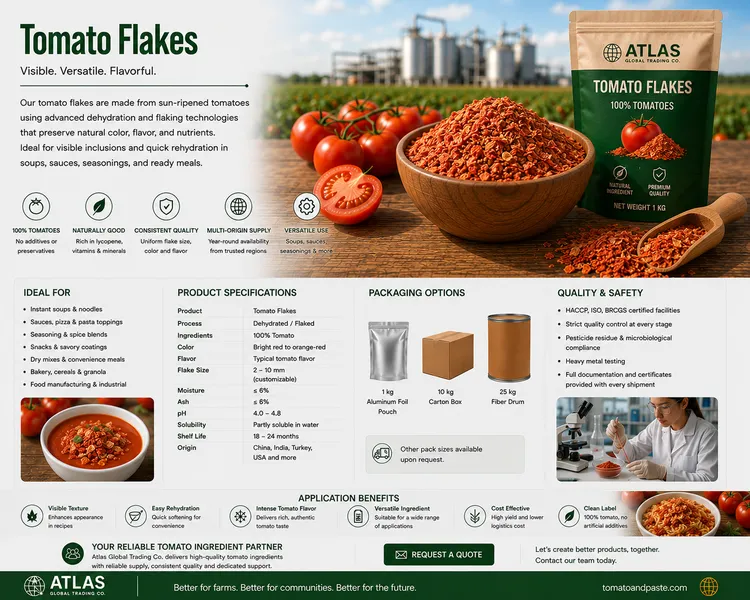
Product overview
Tomato flakes are dehydrated pieces of tomato produced for applications where visible tomato character is desirable without introducing the moisture associated with fresh, canned or liquid tomato ingredients. Their defined particle structure allows them to function as both a flavor component and a recognizable inclusion.
The format can be particularly useful in instant soups, meal kits, savory bakery products, seasoning systems and prepared foods where the tomato should remain visually identifiable before or after reconstitution.
Atlas Global Trading Co. sources tomato ingredients through a multi-origin network of farms, processors and supply partners. We match the ingredient to the customer’s finished-product performance, commercial pack format, documentation requirements, destination and supply program.
Specification focus
Flake size, particle distribution, moisture, color and rehydration behavior are key commercial parameters. The correct flake size depends on the intended visual effect, dosing equipment and whether the product will be consumed dry, cooked or reconstituted.
Buyers may also evaluate the proportion of fines, broken pieces and oversized material. A tighter particle range can support more consistent appearance and dosing, while excessive fines may make the ingredient behave more like a powder in the finished blend.
Moisture is important for shelf stability and handling. Tomato flakes should remain sufficiently dry to maintain flowability and reduce the risk of caking or quality deterioration during normal storage. Exact moisture limits are product-specific and should be defined in the approved specification.
Color and sensory profile may also be commercially important, particularly when flakes are visible in the finished product. Manufacturers may therefore evaluate red color intensity, tomato aroma, cooked notes and the absence of undesirable flavors alongside the analytical specification.
Rehydration and texture
Rehydration behavior is one of the main differences between tomato flakes and finer dry tomato formats. Flake thickness, particle size, processing history, water temperature and contact time can all affect how quickly the ingredient softens and how much recognizable structure remains after preparation.
In instant meals and soups, a flake may need to hydrate quickly enough for the intended preparation method. In cooked products, manufacturers may instead want the pieces to retain some structure after a longer thermal process. Bench testing under realistic processing conditions can help confirm the correct format.
Tomato flakes versus powder and granules
Tomato flakes, granules and powder can all contribute tomato flavor and color, but their physical behavior differs. Powder provides the most uniform dispersion, granules offer controlled small-particle identity, and flakes generally provide the most visible inclusion effect.
The preferred format therefore depends on whether the customer prioritizes homogeneous flavor distribution, dry-flow characteristics, visual tomato identity or a specific rehydrated texture.
Typical applications
- Instant soups and noodle systems
- Ready meals and meal kits
- Bakery and savory bread products
- Seasoning and dry culinary blends
- Rice, grain and pasta preparations
- Prepared foods requiring visible tomato pieces
Storage and handling
Tomato flakes are generally handled as a dry ingredient and should be protected from moisture during transport, warehousing and production. Receiving teams may review bag or carton integrity, lot identification, pallet condition and shelf-life information before acceptance.
Once a pack is opened, exposure to humidity should be minimized because moisture pickup can influence texture, caking and rehydration behavior. Storage temperature, shelf life and handling practices should follow the current supplier specification.
Organic and conventional programs
Where organic supply is requested, we confirm the product’s certification scope and supporting documentation for the selected origin and supply lot. Organic identity should remain aligned with processor certification, product scope and destination-market requirements.
Conventional programs can be optimized around flake size, color, rehydration performance, economics, origin and continuity of supply. Exact technical parameters and commercial availability are confirmed against the selected processor and product program.