
Product overview
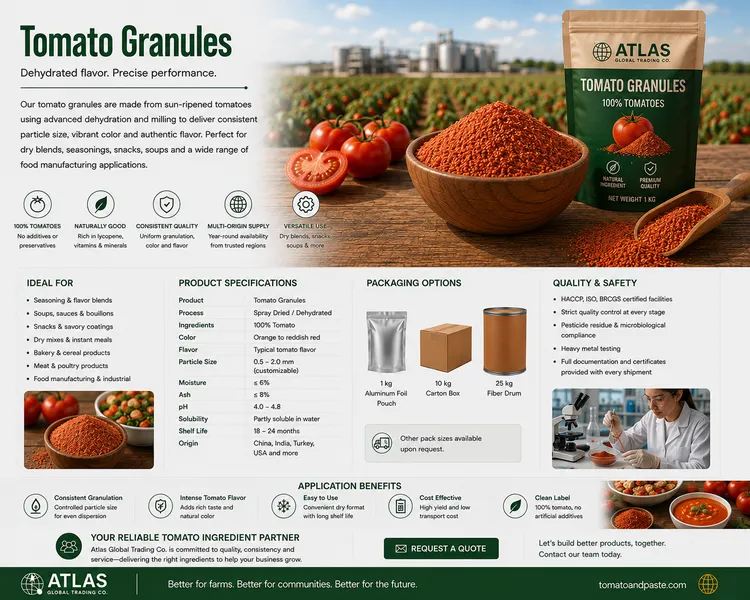
Tomato granules are dehydrated tomato ingredients milled or sized to a controlled granular format. They can provide concentrated tomato flavor, color and solids while also contributing visible particle identity in formulations where a fine powder would be too uniform.
The format is particularly useful in dry seasoning blends, soup mixes, snack applications, meal kits and prepared foods where manufacturers want a dry tomato component that can be dosed, mixed and stored with other low-moisture ingredients.
Atlas Global Trading Co. sources tomato ingredients through a multi-origin network of farms, processors and supply partners. We match the ingredient to the customer’s finished-product performance, commercial pack format, documentation requirements and destination.
Specification focus
Particle-size distribution is one of the primary purchasing parameters. Buyers should define the preferred granule range according to the finished product, dosing equipment and desired visual appearance. Excessive fines or oversized particles may influence blend uniformity, appearance and rehydration behavior.
Flowability is also important in industrial dry systems. Granules should be evaluated for their ability to move consistently through hoppers, feeders, augers and other dosing equipment used in the customer's process. Bulk density and particle shape can contribute to how the ingredient meters and blends.
Additional specification points can include moisture, color, flavor, microbiological limits and rehydration characteristics. In applications that are later cooked or reconstituted, buyers may want to understand how quickly the granules soften and whether they retain visible tomato identity after processing.
Moisture should be controlled carefully because dry tomato ingredients can absorb humidity during storage and handling. Appropriate packaging, liners and warehouse conditions help maintain flowability and reduce the risk of caking.
Granules versus tomato powder
Tomato granules and tomato powder can deliver similar tomato flavor and color but are not always interchangeable. Fine powder generally disperses more uniformly throughout a formulation, while granules can provide visible particles and a different rehydration profile.
The preferred format depends on whether the customer prioritizes rapid dispersion, visual identity, particle texture, dosing behavior or controlled rehydration. Pilot testing can help determine which particle range performs best in the finished system.
Typical applications
- Dry seasoning and flavor blends
- Snack and savory coating systems
- Instant soups and meal mixes
- Prepared-food formulations
- Meal kits and dry culinary components
- Dry sauce and side-dish systems
Rehydration and processing
Rehydration behavior depends on particle size, processing history and the conditions of the finished application. Smaller granules may soften more rapidly, while larger particles may retain more visible structure during shorter preparation cycles.
Manufacturers should evaluate the granules under realistic processing conditions, including water temperature, mixing time, cook time and shear. These variables can influence final texture, appearance and flavor release.
Storage and handling
Tomato granules are generally handled as a dry ingredient and should be stored according to the supplying processor’s recommendations. Receiving teams commonly review package integrity, lot codes, moisture protection, pallet condition and shelf-life information.
Opened packs should be protected from humidity and contamination. Product-specific storage temperature, shelf life and handling guidance should always follow the approved technical specification.
Organic and conventional programs
Where organic supply is requested, we confirm the product’s certification scope and supporting documentation for the selected origin and supply lot. Organic identity should remain aligned with the final product specification, processor certification and destination-market requirements.
Conventional programs can be optimized around particle size, flowability, technical performance, economics, origin and continuity of supply. Exact analytical parameters and commercial availability are confirmed against the selected processor and product program.