
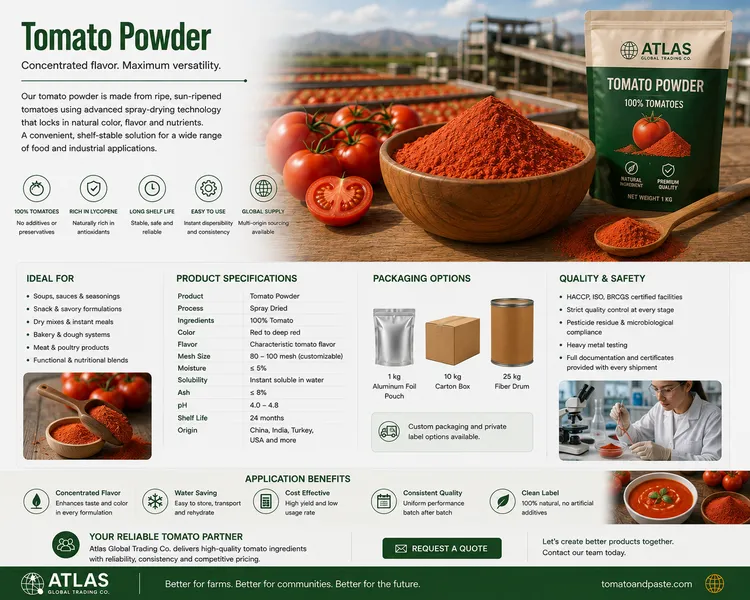
Product overview
Tomato powder is a concentrated dry tomato ingredient designed for applications where manufacturers want tomato flavor, color and solids in a shelf-stable, easily portioned format. It can be incorporated directly into dry formulations or rehydrated as part of a liquid or semi-liquid manufacturing process.
Its low-moisture format makes tomato powder especially useful in seasonings, snack coatings, instant foods, dry sauce systems and bakery formulations where adding conventional tomato paste or puree would introduce unwanted water. The powder can also provide a convenient method of distributing tomato character more evenly through a dry blend.
Atlas Global Trading Co. sources tomato ingredients through a multi-origin network of farms, processors and supply partners. We match the ingredient to the customer’s finished-product performance, commercial pack format, documentation requirements and destination.
Specification focus
Buying parameters can include carrier system, mesh or particle-size distribution, moisture, color, flavor profile, bulk density, dispersibility, flow behavior and microbiological limits. The relative importance of each parameter depends on the customer's application and manufacturing process.
Some tomato powders may be produced with a carrier or processing aid to support drying, flowability or stability. Where formulation or clean-label requirements are important, buyers should define whether carriers are acceptable and request the relevant ingredient declaration for the selected product.
Particle size can influence blending, dusting, coating uniformity, visual appearance and rehydration. A fine powder may be preferred for homogeneous seasoning systems, while different particle distributions may be appropriate where processing behavior or visual character is important.
Moisture and storage conditions also deserve attention because dry tomato ingredients can be sensitive to humidity. Packaging and warehouse practices should therefore help protect the powder from moisture pickup, caking and unnecessary exposure after opening.
Function in dry formulations
In dry systems, tomato powder may contribute color, acidity, sweetness, savory tomato character and concentrated vegetable solids. Its effect should be assessed together with salt, sugar, acids, spices, dairy powders, starches and other flavor components in the formulation.
For products that will later be reconstituted, manufacturers may also evaluate wetting, dispersibility and flavor development after hydration. Bench testing under the actual preparation conditions is useful when comparing different powder sources.
Typical applications
- Seasoning and flavor blends
- Snack coatings and savory dustings
- Instant soups and meal systems
- Dry sauce and gravy mixes
- Bakery products and savory dough systems
- Dry marinades and culinary premixes
- Reconstituted tomato bases
Storage and handling
Tomato powder is generally handled as a dry ingredient and should be stored according to the supplying processor’s recommendations. Buyers commonly evaluate bag integrity, moisture protection, lot coding, pallet condition and shelf-life information during receiving.
Once opened, the product should be protected from humidity and other conditions that could affect flowability, color or flavor. Exact storage temperature, shelf life and handling requirements are product-specific and should be taken from the approved technical documentation.
Organic and conventional programs
Where organic supply is requested, we confirm the product’s certification scope and supporting documentation for the selected origin and supply lot. Carrier systems or other ingredients, where used, should also be compatible with the required organic program.
Conventional programs can be optimized around technical performance, economics, origin and continuity of supply. Exact composition, processing method and specification limits are confirmed against the selected processor and product program.