
Product overview
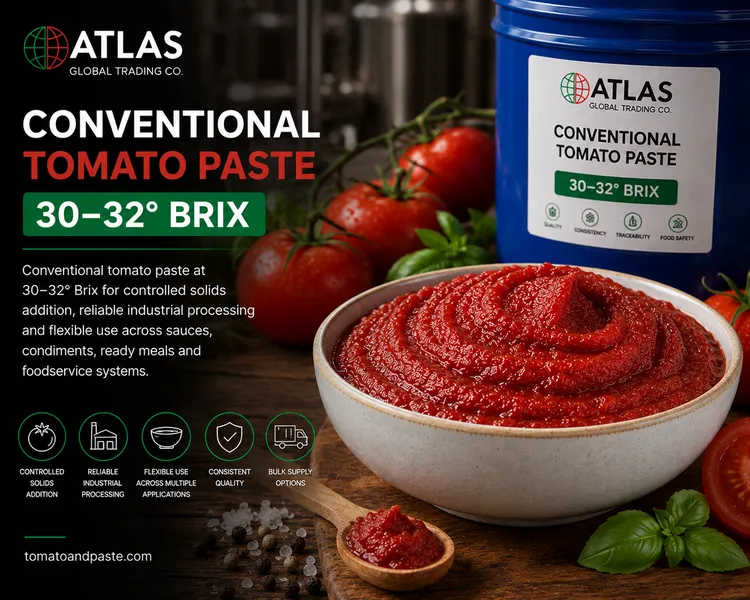
Conventional tomato paste at 30–32° Brix is a widely used industrial concentrate for manufacturers that require a defined level of tomato solids with practical handling and controlled dilution. The concentration provides a useful balance between tomato solids, processing flexibility and reconstitution requirements.
Atlas Global Trading Co. sources tomato ingredients through a multi-origin network of farms, processors and supply partners. We match available programs to the customer’s target Brix, process type, consistency, color, pack format, annual volume and delivery destination.
30–32° Brix concentration
The 30–32° Brix range provides concentrated tomato solids while generally requiring less dilution than higher-solids formats such as 36–38° Brix. It is commonly selected where manufacturers want a concentrated but versatile tomato base for routine industrial processing.
The exact concentration should be considered together with the final formulation. Water addition, other liquid ingredients and additional tomato components all affect the finished-product solids and consistency.
Process and finish options
Available process and finish options are subject to crop conditions and processor capability. Depending on the supply program, customers may review hot break or cold break characteristics, consistency, finish and other product-specific processing parameters.
Process type can influence viscosity, flavor and how the paste performs during dilution and cooking. Buyers should therefore evaluate the full technical specification rather than selecting on Brix alone.
Specification focus
Buyers commonly evaluate soluble solids, process type, consistency or Bostwick, color, pH, acidity, finish and microbiological parameters. Commercial sterility, flavor profile and packaging requirements may also form part of the agreed specification.
Products with the same nominal Brix may differ in flow behavior, texture or color depending on origin and process conditions. These differences can affect pumping, blending and finished-product performance.
Reconstitution and formulation
Tomato paste in the 30–32° Brix range can be diluted to the solids level required for sauces, soups and other formulations. It may also be blended with puree, diced tomatoes, seasonings, vegetables or other components to develop the desired texture and tomato intensity.
Controlled solids addition allows manufacturers to standardize recipes more precisely across different production batches, provided the incoming paste specification remains within the agreed range.
Typical applications
- Cooking, table and pasta sauces
- Condiments and savory dressings
- Ready meals and prepared foods
- Foodservice sauces and bases
- Industrial tomato bases
- Soups and culinary systems
Industrial handling considerations
Handling performance depends on consistency, product temperature, pump type and line configuration. Manufacturers should confirm that receiving and blending equipment are suitable for the selected paste specification and pack format.
When switching between processors or origins, customers may wish to validate pumping, dilution and mixing behavior under production-representative conditions to maintain consistent finished-product performance.
Aseptic bulk packaging
Industrial 30–32° Brix tomato paste is commonly supplied in aseptic packaging such as sterile bags in drums or larger bulk bins, subject to processor and origin. Exact net weights, liner systems, palletization and loading configuration vary by supply program.
Storage conditions and shelf life remain product-specific and should be confirmed on the current technical specification and applicable lot documentation.
Conventional supply programs
Conventional programs can be optimized around technical performance, economics, origin, freight efficiency and continuity of supply. Multi-origin sourcing can provide additional flexibility where buyers need to balance specification requirements with crop availability and shipment timing.
Documentation and commercial planning
Depending on the selected program, documentation may include the current technical data sheet or specification, certificate of analysis and relevant lot or shipment records. Exact document availability is confirmed with each commercial offer.
A complete inquiry should include target Brix, preferred process type where relevant, consistency requirements, color expectations, pack format, annual or shipment volume, documentation needs and delivery destination.